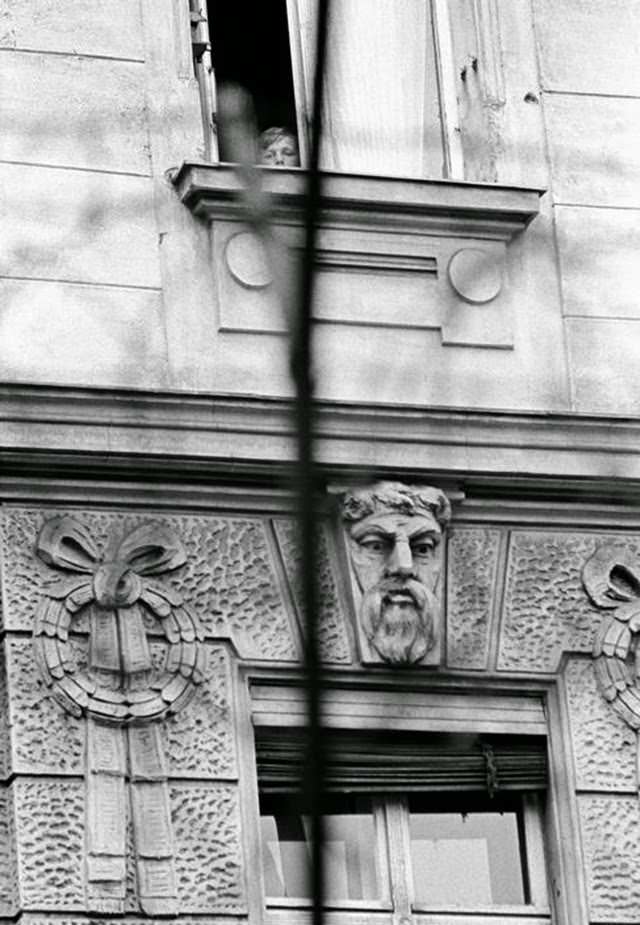
High above the street, a young boy leans into an open window, his face half-hidden by the frame as if testing how much of the world he’s allowed to see. A dark vertical line cuts through the scene like a visual scar, echoing the idea of a border that isn’t only mapped on paper but imposed on everyday life. The moment feels quiet and ordinary, yet the tension of separation hangs in the air.
Below the window, the building’s ornate façade—ribbons carved in relief and a stern stone face—speaks of an older Berlin that long predates the Cold War divide. That contrast is striking: heavy architecture designed for permanence, and a child’s fleeting glance that hints at uncertainty. Even without showing the Wall directly, the photograph suggests its presence through framing, distance, and the sense that the city’s spaces are being watched, measured, and restricted.
Near the border wall between East and West Berlin, small gestures like looking out a window could carry the weight of longing, curiosity, or fear. The boy’s upward perch invites readers to consider what it meant to grow up with a barrier running through a living city—splitting neighborhoods, routines, and families. For anyone searching for Berlin Wall history photos, Cold War Berlin stories, or images of everyday life in divided Germany, this scene offers a personal, haunting entry point into a larger political conflict.