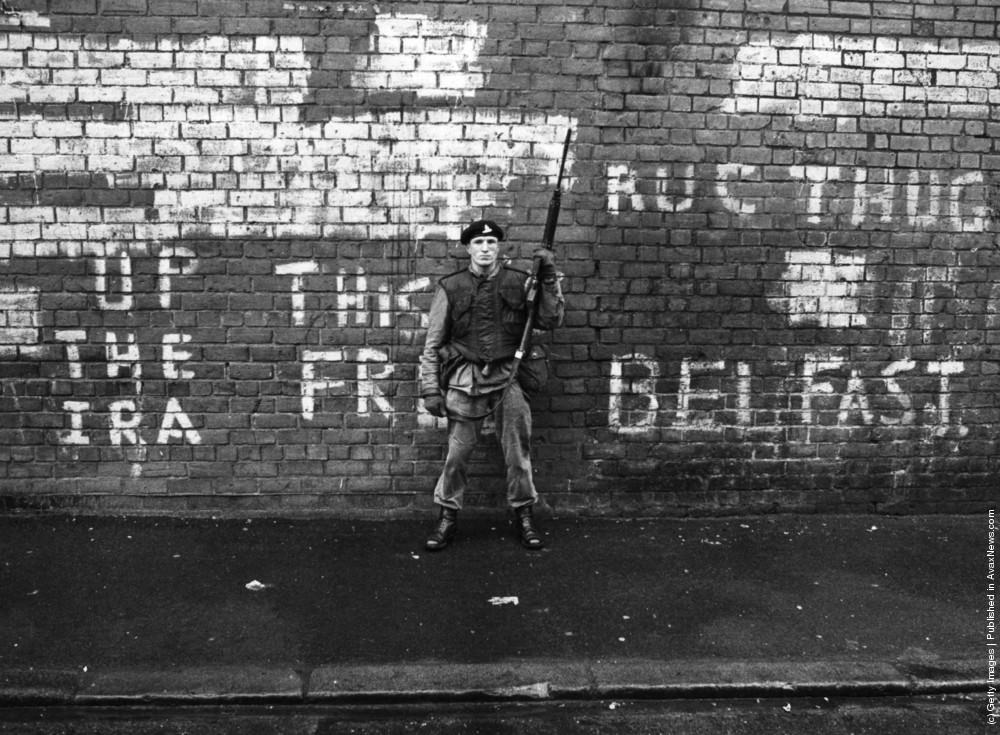
A lone British soldier stands guard in Belfast on 24 March 1971, his rifle held upright as he faces the camera with a still, watchful expression. The street around him is empty, the curb and pavement forming a hard line that frames his stance, while his uniform and beret signal military authority in the midst of an unsettled city. Even without motion, the posture suggests patrol duty—present, alert, and meant to be seen.
Behind him, a brick wall becomes a second battlefield, layered with political graffiti that includes “IRA” and other large, rough-lettered slogans. The peeling paint and uneven lettering hint at hurried nights and contested messages, turning ordinary masonry into a public noticeboard for intimidation, identity, and defiance. In this single frame, the soldier and the wall speak to each other: state presence set against the language of insurgency and community tension.
Seen today, the photograph reads as a stark document of the Troubles-era security landscape, where patrols, propaganda, and everyday streets collided. The scene’s quietness is part of its power—no crowd, no vehicles, just a figure in uniform and the marks left by anonymous hands—capturing how “civil wars” can be fought through visibility as much as violence. For readers searching the history of Belfast in 1971, British Army patrols, and the meaning of political murals and graffiti, this image offers an unvarnished starting point.