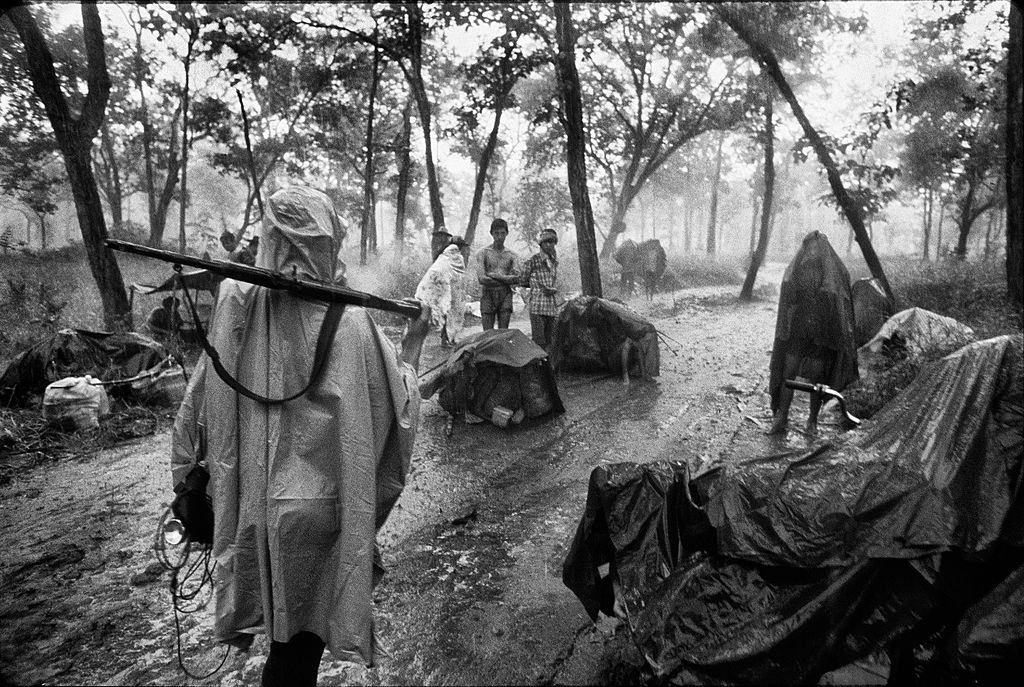
Rain turns the border road into a ribbon of mud, and the tree line offers only thin shelter against the downpour. Figures move through the wet haze under improvised coverings, while bundles and tarps lie heaped along the track like temporary homes. A rifle slung across one person’s back underscores how, in civil war, displacement and armed struggle can occupy the same narrow space.
Along this Thai border landscape, Cambodian refugees and pro‑Sihanouk guerrilla appear caught in a holding pattern, waiting for order that has not yet arrived. The rainy season magnifies every hardship: soaked clothing, churned ground, and the constant work of keeping possessions dry when there is nowhere permanent to go. In the distance, a few people stand and watch, their stillness contrasting with the urgent, practical movements of those hunched over their loads.
Before Thai authorities and the United Nations could establish proper camps, scenes like this marked the raw first stage of a refugee crisis—an in‑between world of makeshift shelter and uncertain protection. The photograph reads as both a document of Southeast Asia’s civil wars and a reminder of how quickly borders become lifelines when violence pushes civilians outward. For readers searching the history of Cambodian refugees, the Thai border, and the realities of monsoon displacement, this image offers a grounded, sobering glimpse of survival before aid systems could catch up.