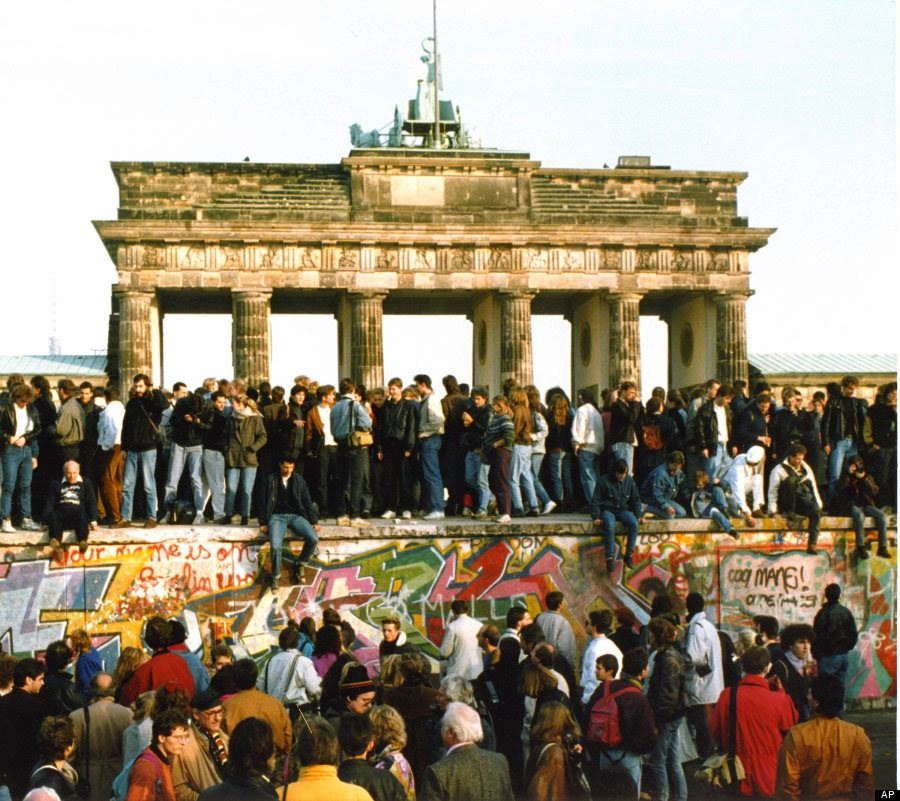
Crowds gather atop the Berlin Wall beneath the columns of the Brandenburg Gate, turning a once-forbidden border into an improvised balcony of celebration. The concrete barrier in the foreground is layered with bright graffiti and shouted slogans, while people in jackets and jeans stand shoulder to shoulder, looking outward and downward as if testing whether the old rules still apply. Faces blur into a single restless public mood—curiosity, relief, and disbelief sharing the same narrow ledge.
Taken on Nov. 10, 1989, the scene evokes the immediate aftermath of a political earthquake, when East and West Berliners began crossing, meeting, and reclaiming streets that had been cut in half for decades. The Wall’s harsh geometry is still there, yet its meaning is visibly collapsing under the weight of ordinary citizens who climb it, sit on it, and treat it as a platform rather than a threat. In the shadow of the Gate, a monument long trapped behind the frontier becomes a backdrop for a new, unplanned civic ritual.
What makes this historical photo so powerful is its mixture of the monumental and the everyday: a world-famous landmark, a scar of Cold War division, and a crowd dressed for an ordinary day that suddenly became extraordinary. For anyone searching for Berlin Wall history, the fall of the Berlin Wall, or images of the Brandenburg Gate in 1989, this moment distills how quickly a “no-go” zone can transform into public space. It’s less a tidy ending than a vivid turning point—people literally standing on the border as Europe’s map, and its memories, begin to change.