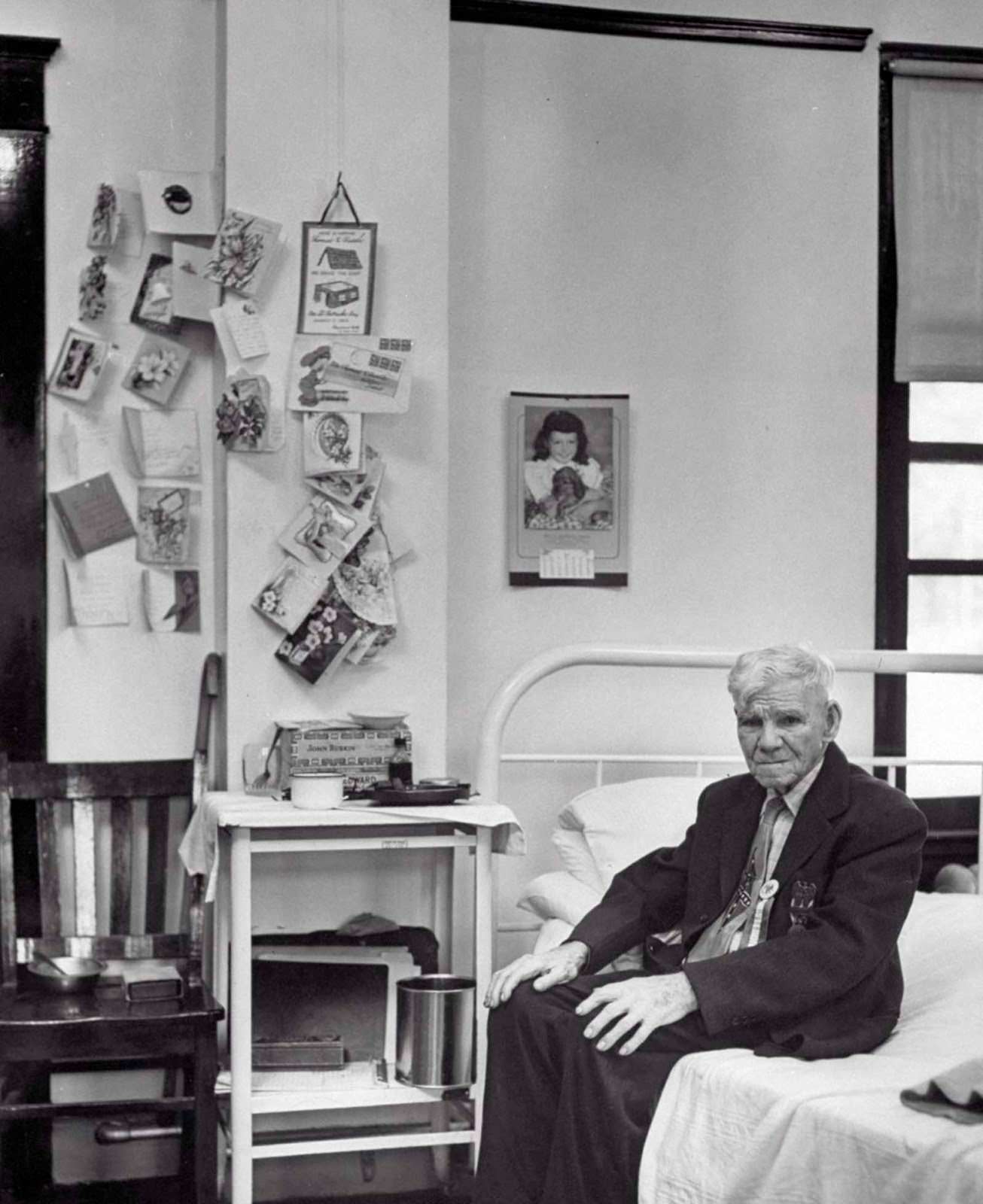
Thomas Evans Riddle sits at the edge of a neatly made bed in 1953, his suit jacket buttoned and his posture steady despite the weight of years. The lines in his face and the direct, unembellished gaze suggest someone accustomed to endurance—an elderly Civil War veteran living long enough to be photographed in the modern era. It’s a quiet portrait, the kind that invites you to look past the surface and consider the long span of American history carried in one life.
Around him, the room tells its own story of routine and remembrance: a simple bedframe, a small table with a cup and reading material, and a wall crowded with pinned cards and small notes—messages that feel like the everyday ties of family, friends, or a caring community. A calendar with a child’s portrait hangs nearby, a tender counterpoint to the veteran’s stern expression and a reminder that generations overlap in unexpected ways. Details like these ground the photograph in domestic reality, far from battlefield imagery, yet still shaped by what the Civil War left behind.
For readers searching Civil War history, veteran portraits, or mid-century Americana, this image offers a rare bridge between the 1860s and the 1950s. Riddle is presented not as a symbol on a monument, but as an aging man in a lived-in space—proof that the conflict’s human echoes persisted well into the twentieth century. Spend a moment with the small objects in the frame and the calm formality of his dress, and the photograph becomes less about spectacle and more about the long afterlife of war in ordinary rooms.