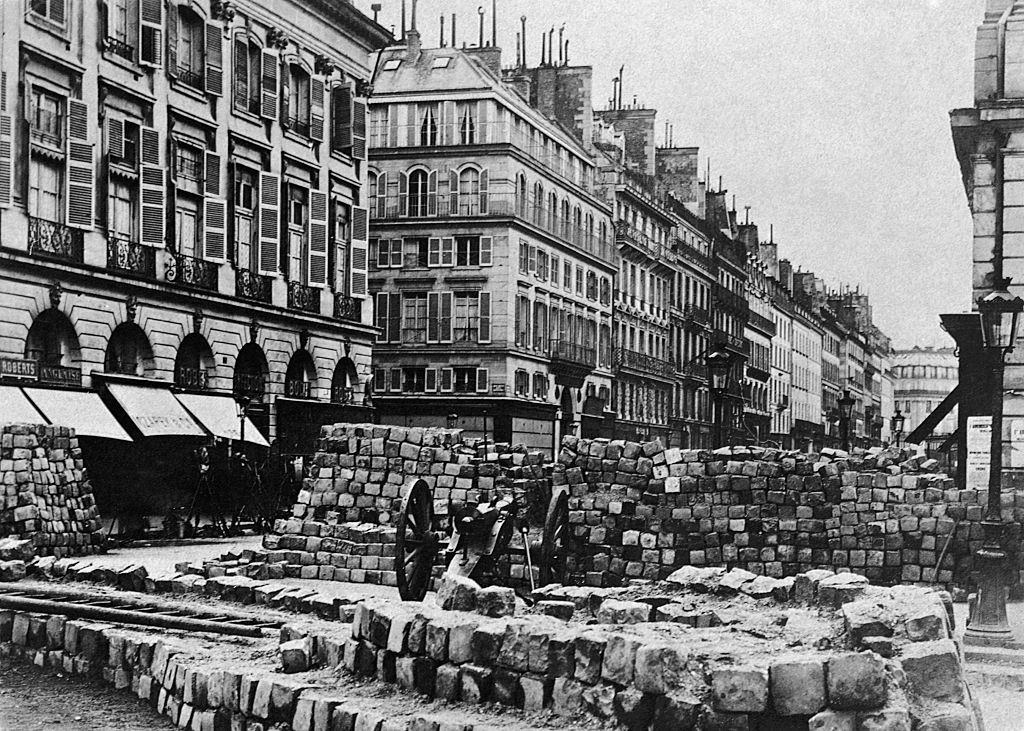
Stone blocks are piled into a blunt wall across a Paris street, turning an elegant boulevard of shuttered windows and arcaded storefronts into a hard-edged fortification. A cannon sits just behind the barricade, its wheels half swallowed by churned-up ground and scattered masonry, while rough heaps of rubble mark where paving has been torn up for defense. The long perspective of façades and chimneys emphasizes how abruptly ordinary urban life could be interrupted by the Franco-Prussian War.
Along the left side, shop awnings and signage linger as reminders of commerce, now overshadowed by the improvised geometry of stacked stones. The barricade’s careful height and thickness suggest urgency mixed with method, as if the city itself had been reassembled into a weapon. Even without a crowd, the scene feels tense—quiet architecture facing off against the expectation of artillery and advancing troops.
For readers exploring Paris under siege, this photograph offers a vivid entry point into street-level wartime preparations and the realities of civil conflict in a modern capital. It illustrates how defensive works could be built from the city’s own materials, transforming pavements, curbstones, and building blocks into barriers and gun positions. Whether you’re researching the Franco-Prussian War, Paris barricades, or the broader history of 19th-century urban warfare, the image captures the stark meeting of daily life and military necessity.