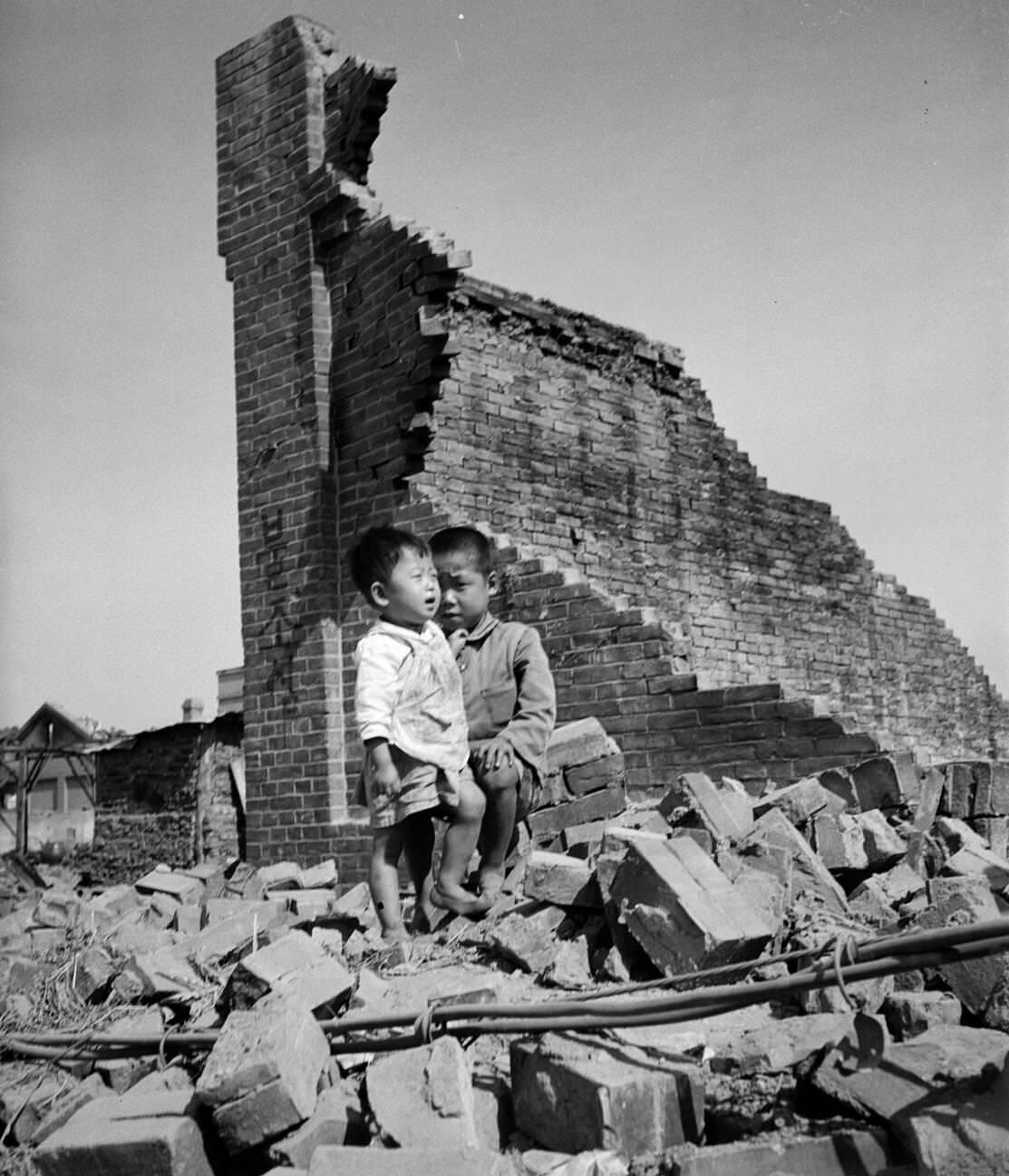
Against a jagged wall of shattered brick, two small boys stand amid a sea of rubble, their thin clothing and bare legs stark against the hard geometry of destruction. One child faces outward with his mouth slightly open, as if calling to someone beyond the frame, while the other stays close behind, watchful and guarded. The ruined structure towers above them like a broken monument, turning an ordinary street into a landscape of loss.
Incheon, named in the title, was battered during the Korean War, and scenes like this speak to the civilian upheaval that followed fighting through neighborhoods and ports. The debris underfoot—splintered masonry, fallen timbers, and twisted lines—suggests not only collapsed buildings but collapsed routines: homes erased, schools interrupted, families scattered. When the camera lingers on children rather than soldiers, the conflict becomes less a matter of front lines and more a story of survival in the aftermath.
Orphanhood in wartime is both a personal tragedy and a social crisis, and this photograph encapsulates that tension with painful clarity. The boys’ closeness hints at a fragile kind of protection, as if companionship itself is a shelter when walls no longer stand. For readers searching Korean War history, Incheon ruins, or civilian life in the 1950s, this image offers a sobering reminder that the cost of war is often measured in the smallest footsteps picking their way through the stones.