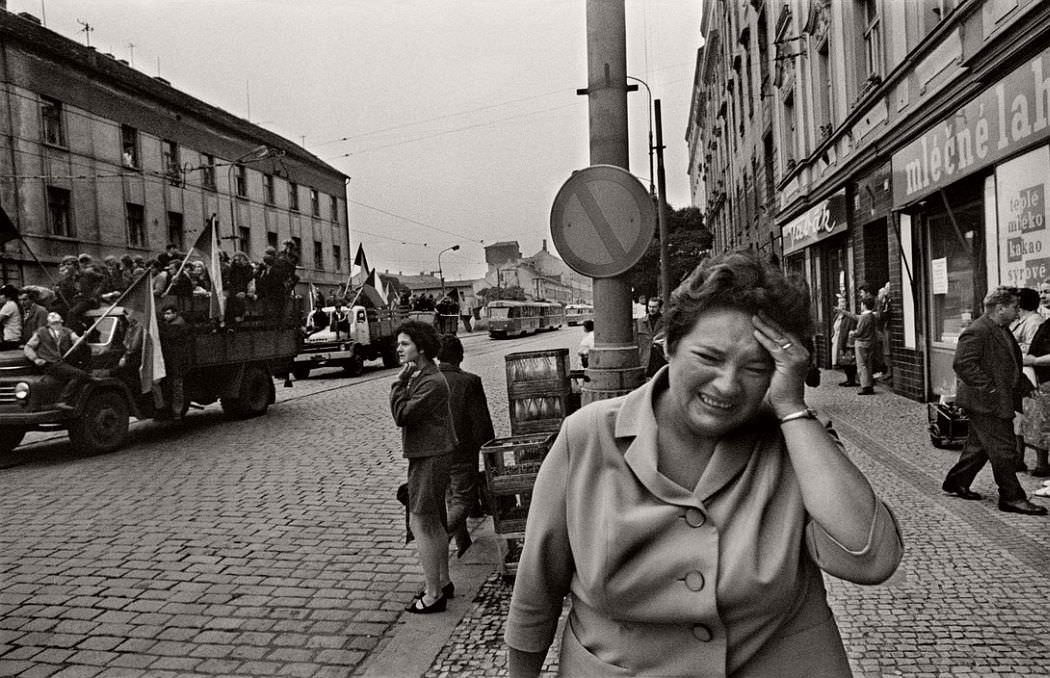
Grief is written across the foreground as a woman clutches her head, caught mid-step on a cobbled street while the world behind her lurches into crisis. To the left, a military truck crowded with soldiers rolls past, flags fluttering above the packed bed; to the right, everyday storefronts and onlookers frame the scene in uneasy normality. The contrast between domestic routine and armed arrival makes the moment feel brutally immediate, as if a city’s breath has been taken away.
Across Czechoslovakia in 1968, the Prague Spring became a symbol of reform hopes inside the Eastern Bloc, and the Soviet-led invasion moved swiftly to smother them. The photo’s street-level perspective avoids grand battlefield drama and instead emphasizes what occupation looks like up close: confusion, fear, and the sudden presence of power on ordinary corners. Faces turned toward the vehicles, hesitant movements, and the sheer proximity of soldiers and civilians all speak to a society forced to witness history in real time.
For readers searching for the human story behind the Soviet invasion of Czechoslovakia, this image offers a stark entry point into the tension between politics and personal life. It suggests how “civil” spaces—shops, sidewalks, transit lines, and familiar routes—can become contested territory when tanks and troops arrive to crush a movement. As part of a Civil Wars collection, the photograph reminds us that upheaval is measured not only by proclamations and borders, but by the private pain of those who must endure the turning of an era.