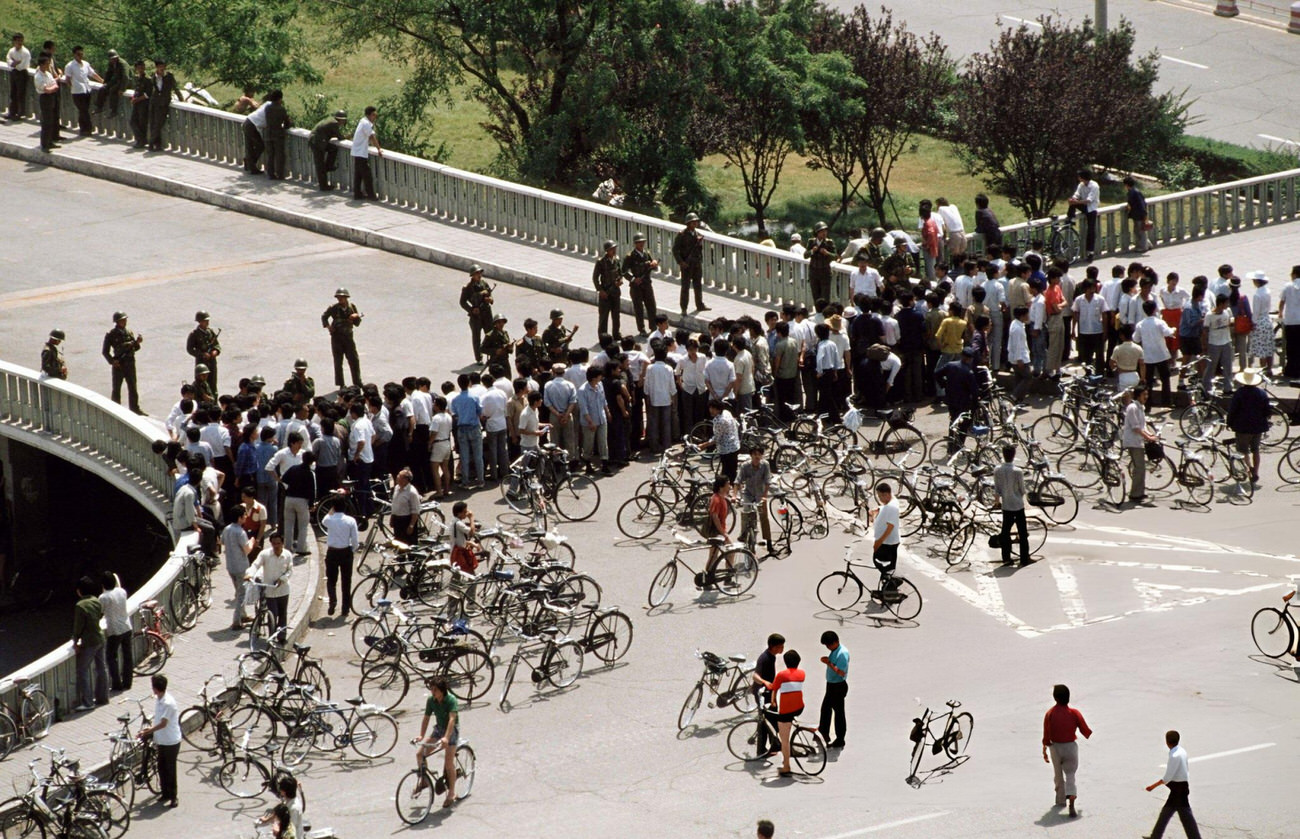
Along Chang’an Avenue, an overpass becomes a sudden chokepoint as Chinese soldiers form a line across the roadway leading toward Tiananmen Square. The camera’s elevated angle turns the scene into a study of order and uncertainty: uniforms spaced out across the concrete, civilians clustering at the edges, and a city’s everyday traffic pattern abruptly rewritten. Even without close-up faces, the tension is legible in the distance kept between groups and the way the bridge railing doubles as a boundary.
Below and around the overpass, bicycles dominate the frame, scattered and stacked in informal rows that hint at interrupted commutes and hurried decisions. Small knots of onlookers gather along the sidewalks, some leaning over the barrier to watch what unfolds, others standing back as if gauging how close is too close. The bright midday light and leafy median make the setting feel ordinary, which only sharpens the contrast with the armed presence and the controlled stoppage of movement.
Dated in the title to 1989, the photograph sits within the larger, contested memory of Beijing during a year of mass demonstrations and state response. It reads as a moment of transition—between motion and standstill, public space and restricted access—captured not in a single dramatic gesture but in the quiet mechanics of a blockade. For readers searching for Tiananmen Square 1989, Chang’an Avenue, or Chinese soldiers overpass imagery, this frame offers a grounded street-level perspective on how history can be enforced one intersection at a time.