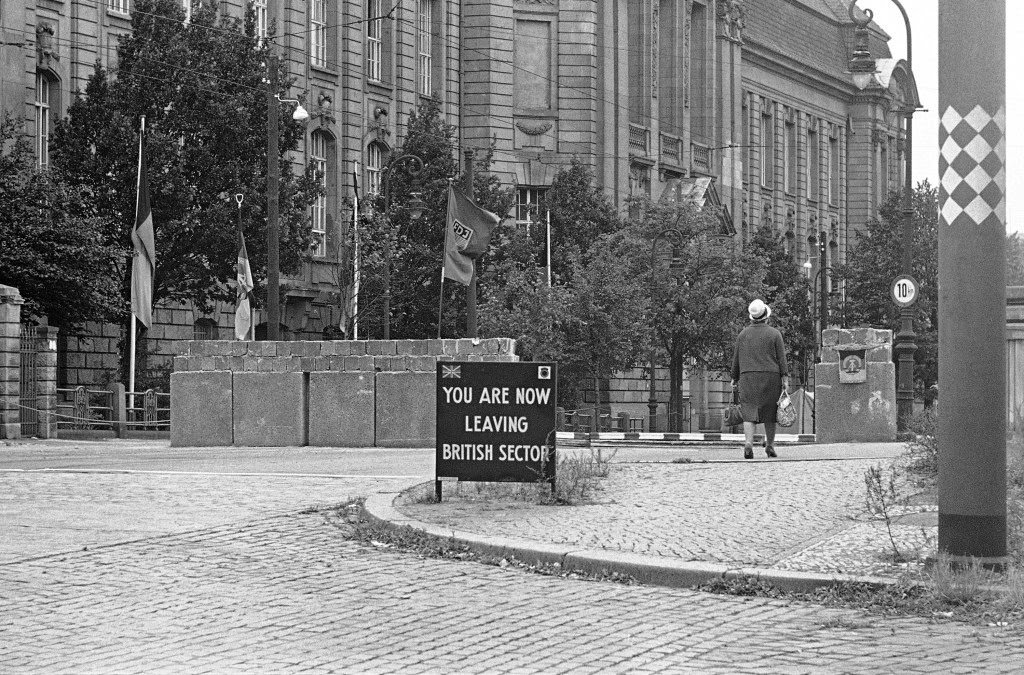
Cobblestones lead the eye toward a blunt line of concrete blocks at the Invalidenstrasse crossing point, where small flags and newly placed emblems announce authority in the most literal way. A stark roadside sign—“YOU ARE NOW LEAVING BRITISH SECTOR”—turns a familiar urban street into a threshold, as if a routine walk could become an international crossing. The surrounding façades and trees feel almost ordinary, which only sharpens the shock of the barrier cutting through the city’s daily rhythm.
Set on Sept. 9, 1961, the scene sits in the tense early weeks of the Berlin Wall’s rise, when borders between the British and Russian sectors hardened from lines on maps into obstacles of stone and policy. The flags perched above the wall read as more than decoration; they are declarations, meant to be seen, remembered, and obeyed. Here the Cold War becomes physical—measured in blocks, curb lines, and the language of signage.
In the distance, a lone pedestrian moves along the edge of the checkpoint, underscoring how quickly private lives were forced to navigate public divisions. The photograph’s quiet composition makes room for the larger story: a city partitioned, a crossing constrained, and a new normal imposed with concrete and symbols. For readers searching Berlin Wall history, East Berlin authorities, or the 1961 sector border in Berlin, this image offers a precise snapshot of separation taking shape on the street.