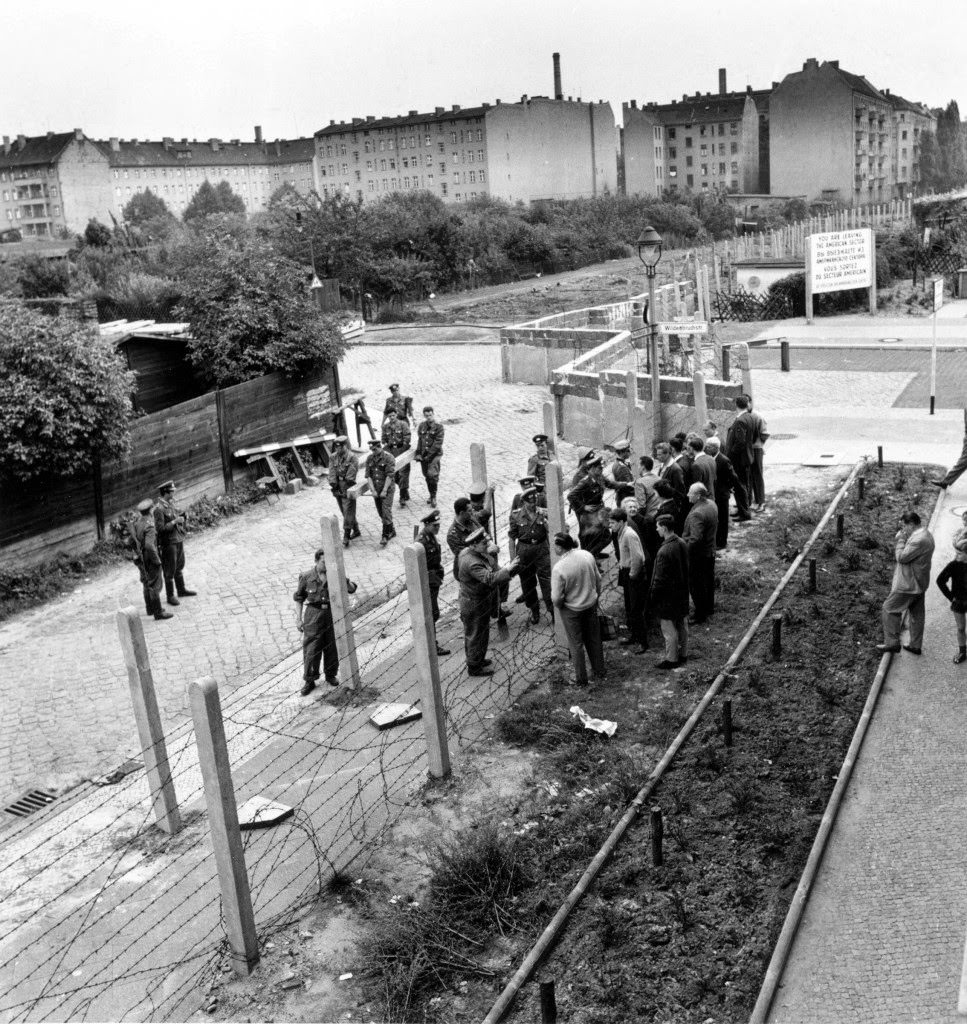
Barbed wire runs like a harsh pencil line across the street, turning an ordinary Berlin block into a guarded frontier in September 1961. On one side, West Berliners gather in a tight cluster, leaning in to speak across the fence; on the other, East Berlin policemen stand in uniformed knots, watching and answering through the gaps. Apartment buildings rise behind them, indifferent backdrops to a sudden new reality of separation.
What feels most striking is how quickly the border looks “normal” in the frame: posts set in place, wire stretched taut, patrols posted at measured intervals. Yet the scene is anything but routine—faces turn toward one another at close range, voices forced into brief exchanges by distance and barriers, while a few bystanders hang back as if unsure how to behave in this freshly divided city. The fence does more than block movement; it reorganizes the street itself, reshaping where people stand, how they talk, and what they dare to ask.
For readers exploring Cold War history, the early Berlin Wall era, or Germany’s postwar division, this photograph offers a grounded, human-scale view of a geopolitical crisis. It captures the border not as a distant concept but as a lived encounter—civilians and police negotiating a tense new boundary in public, under watchful eyes. The result is a powerful historical image of West Berlin and East Berlin at the moment when conversation remained possible, even as the wire insisted it would not last.