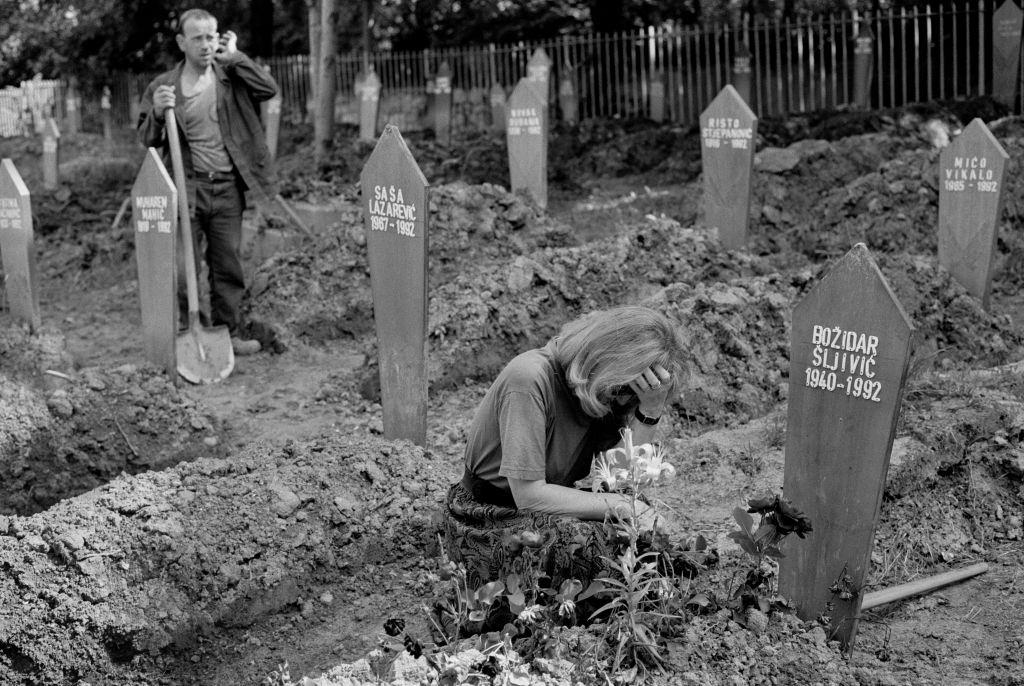
July 1992 hangs heavy over the Lion Cemetery, where fresh earth lies heaped in long, raw mounds and simple wooden markers rise in uneven rows. A woman kneels close to one grave, her posture folded inward, hand covering her face as if to shield herself from what cannot be endured. Small flowers—delicate against the churned soil—become a quiet offering in a landscape shaped by sudden loss.
Behind her, a man stands with a shovel planted in the ground, caught between labor and disbelief, while more graves stretch toward a fence line and trees beyond. The headboards bear names and years, turning private lives into stark inscriptions, and the repeated endings in 1992 speak to a moment when death arrived in clusters rather than in solitude. Together, these details place the scene firmly within the grim routines of civil wars: hurried burials, crowded plots, and families forced to mourn in public.
What makes this historical photo so enduring is its restraint—no spectacle, only the ordinary geometry of a cemetery and the extraordinary weight of grief. The Lion Cemetery becomes more than a location; it reads as a record of a community absorbing conflict one burial at a time, with each marker a fragment of a larger tragedy. For readers searching the history of the 1990s civil wars, wartime mourning, and the human cost etched into cemeteries, this image offers an unflinching, intimate witness.