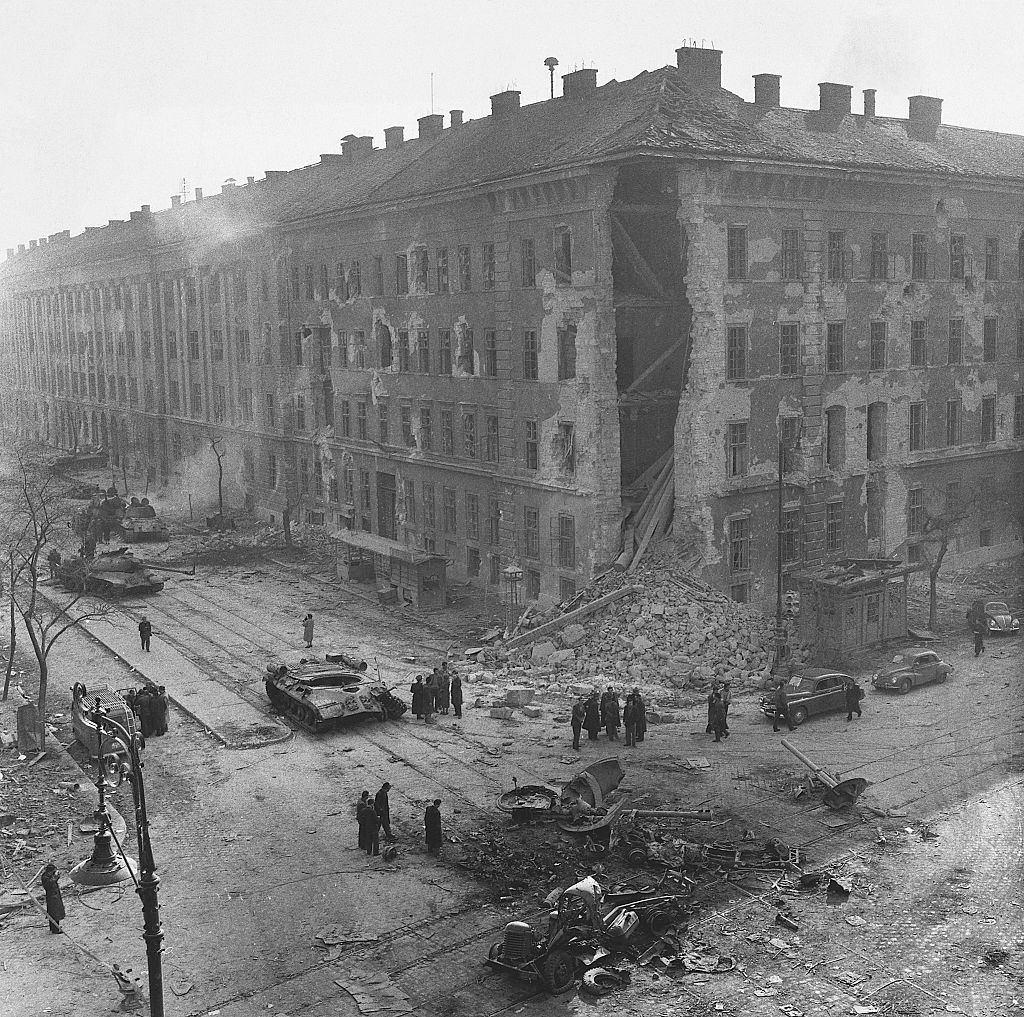
A hulking barracks building dominates the frame, its façade scarred and partially torn open, with a mound of rubble spilling onto the street below. In front of it sit Soviet tanks and other military vehicles, their hard silhouettes cutting across tram tracks and broken pavement. Small knots of civilians and soldiers linger in the open space, dwarfed by the architecture and the machinery, while wreckage and twisted debris hint at recent fighting.
The title anchors the scene to the invasion of Hungary by Russian troops to suppress the anti-Communist revolution, and the photograph reads like a quiet aftermath rather than a battlefield in motion. The damaged walls and exposed interior of the Kilian Barracks suggest bombardment or close-range clashes, while the scattered metal remains in the foreground speak to improvised defenses and the brutal logic of urban combat. Even without a specific timestamp visible, the atmosphere conveys a city forced into pause—streets cleared not by peace, but by occupation.
For readers exploring Cold War history, the Hungarian Revolution, and the visual record of Soviet intervention, this image offers a stark, grounded perspective on what “suppression” looked like on the street. It balances military presence with the human scale of bystanders and observers, emphasizing how quickly everyday spaces become contested terrain during civil unrest. As a historical photo, it serves both as documentation and as a reminder of the costs borne by buildings, neighborhoods, and ordinary people when power is enforced at gunpoint.