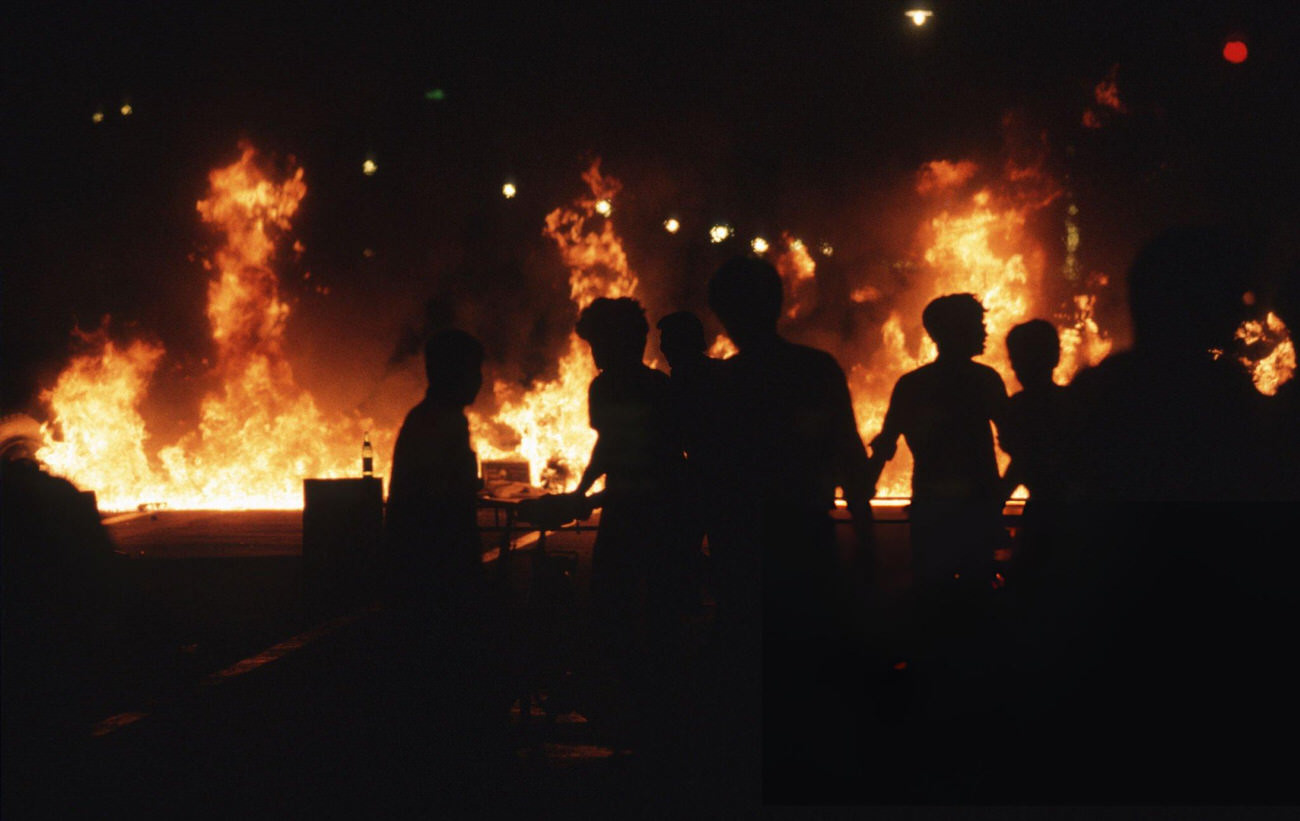
Firelight dominates the night on Chang’an Avenue, turning buses and other vehicles into blazing hulks while the street beyond dissolves into smoke and darkness. In the foreground, figures are reduced to silhouettes—heads turned, bodies angled away—caught in the uneasy moment between standing ground and stepping back. The scattered points of streetlights and the distant red signal only sharpen the sense of a cityscape overwhelmed by sudden violence.
What makes the scene so haunting is its mix of scale and immediacy: a broad, iconic boulevard becomes a corridor of heat, glare, and retreat. The title’s reference to pro-democracy demonstrators frames these shadows as civilians navigating danger, their movement away from the flames suggesting both survival and the collapse of a fragile opening for political expression. Without relying on close-up faces, the photograph conveys fear, urgency, and the disorienting speed with which public protest can be swallowed by chaos.
For readers searching the history of the 1989 Beijing demonstrations and the crackdown that followed, this image offers a stark visual entry point into that turning moment. Burning vehicles, massed smoke, and the retreating line of people underline how quickly a protest landscape can transform into something resembling civil conflict on an urban thoroughfare. It’s a reminder that the record of 1989 is not only written in slogans and speeches, but also in the dark, flickering margins where ordinary people had to decide, step by step, how to stay alive.