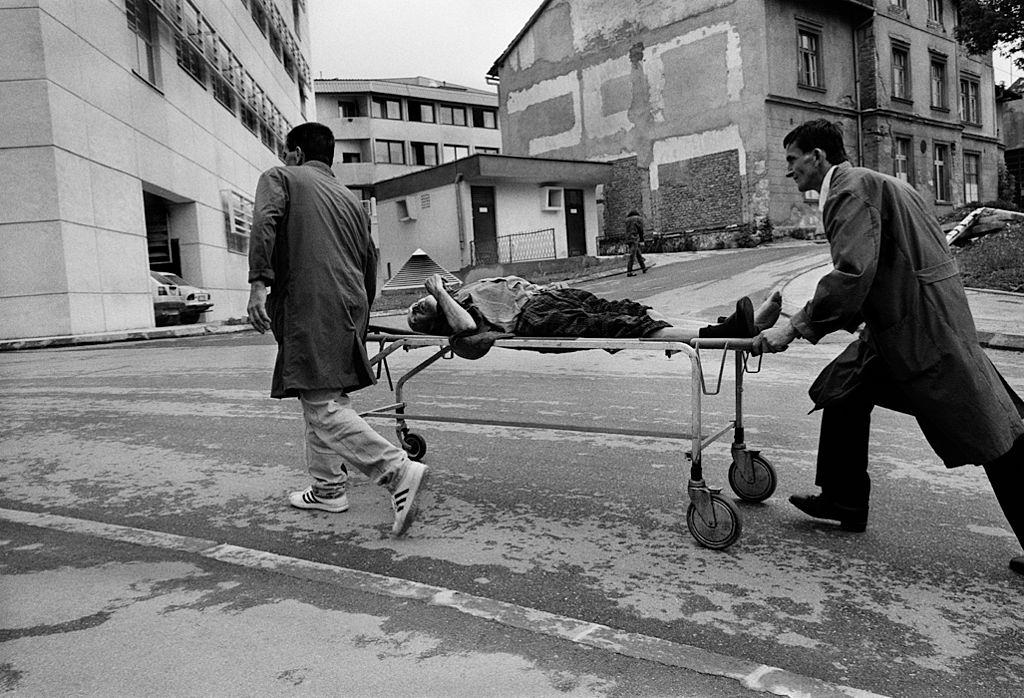
Urgency drives every line of this scene as two hospital porters push a stretcher at speed across a bare stretch of roadway, the wounded man’s body jolting with each step. Their coats flare with motion, heads angled forward, intent on shaving seconds off the trip to the emergency room. Behind them, stark hospital blocks and worn apartment facades create a hard urban corridor where normal life has been interrupted by war.
Set during the Siege of Sarajevo in Bosnia, in July 1992, the photograph compresses the violence of shelling into its aftermath: a civilian casualty and the scramble to keep him alive. The open street offers little shelter, making the dash itself feel like part of the danger, while the stretcher’s thin frame and small wheels underline how improvised survival could be in a city under fire. Even the empty space around the figures—few cars, few bystanders—suggests a place where movement was calculated and risk was constant.
For readers tracing civil wars and humanitarian response in the Balkans, this image speaks to the unglamorous, essential labor of medical workers and support staff who kept hospitals functioning amid shortages and chaos. It is also a reminder that Sarajevo’s siege was lived at ground level, measured in corridors crossed, doors reached, and minutes gained or lost. As a piece of historical documentation, the photo anchors the conflict in human effort: hands gripping metal rails, feet pounding pavement, and a community’s fragile line between injury and care.