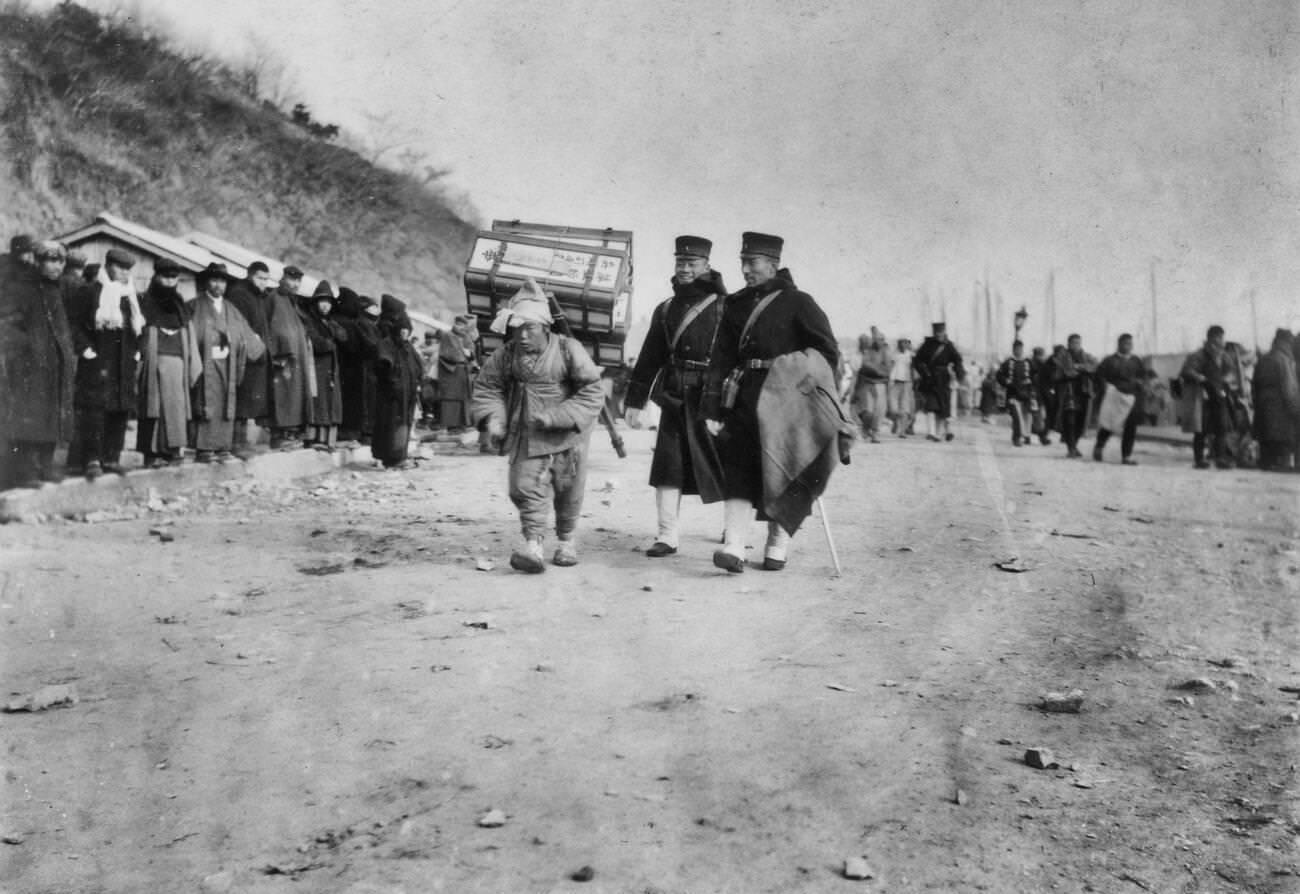
Bent forward under a wooden crate lashed to a carrying frame, a Korean laborer trudges along a rough shoreline road, his winter clothing and headwrap suggesting cold air and hard ground. Behind him, a line of bundled onlookers hugs the edge of an embankment, their attention fixed on the procession moving through the open space. The scene has the feel of a temporary wartime corridor—improvised, crowded, and built around the urgent movement of supplies.
Two uniformed men walk close at his side, their long coats, caps, and gear contrasting sharply with the porter’s simpler dress and heavy burden. The crate itself reads as precious cargo: medical supplies meant to travel from ship to shore and onward to a hospital, where bandages, instruments, and medicines could mean the difference between recovery and loss. Details like the scattered stones underfoot and the distant figures lining the route underline how physical and exposed this kind of logistics work could be in 1904.
Set against the post’s “Civil Wars” theme, the photograph points to the often-overlooked workforce that made military medicine possible—men hired or compelled to carry what armies could not easily move on their own. It’s a stark reminder that behind every field hospital and every treated wound lay hours of backbreaking transport, performed far from the commanding officers and the headlines. For readers searching Korean history, wartime medical logistics, or early 20th-century labor, this image offers a grounded, human-scale window into the era’s realities.