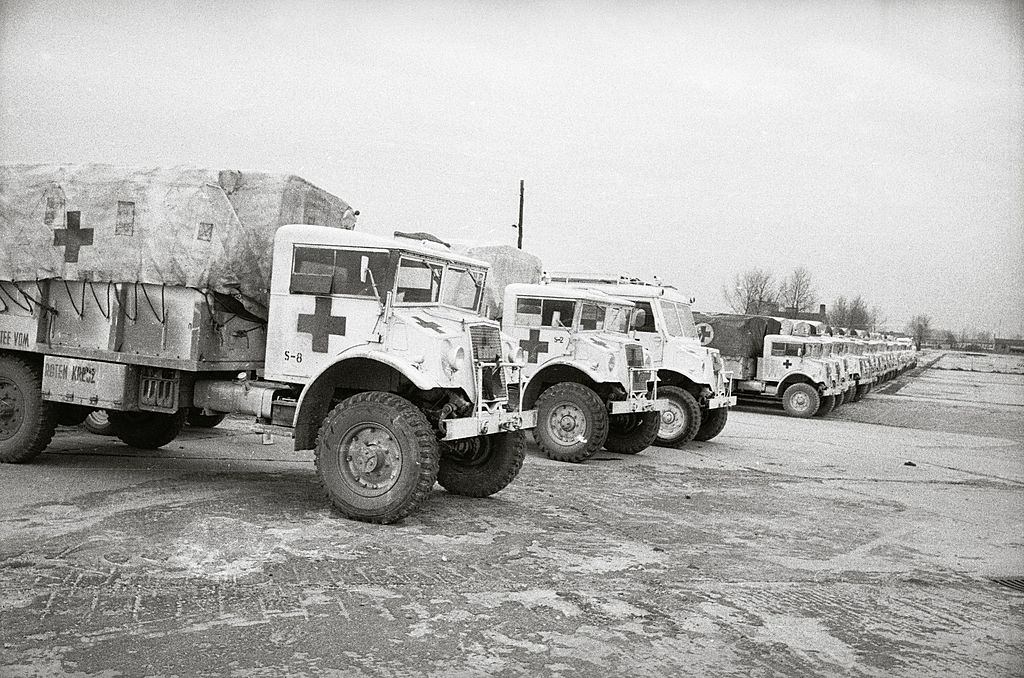
A long line of heavy trucks sits patiently on a wide, empty roadway, each vehicle marked with prominent Red Cross symbols that signal their purpose before a single mile is driven. Canvas-covered loads rise above the beds like bundled promises—medical supplies, food, blankets—packed for urgency yet waiting on orders, clearance, and safe passage. The scene feels cold and quiet, the stillness of a convoy staged for motion, where compassion is organized into steel, tires, and tarpaulin.
Set against the title’s reference to Hungary in 1956, the photograph reads as a logistical pause in the middle of a humanitarian emergency. These aid trucks represent more than transport; they hint at the networks of volunteers, donors, and relief agencies who tried to respond quickly as crisis spread and civilians bore the consequences. Even without showing crowds or battle damage, the image carries the tension of that era—help assembled at scale, ready to cross borders into uncertainty.
Civil wars and uprisings are often remembered through dramatic front-line images, but relief work has its own stark visual language: queues, markings, and the disciplined repetition of vehicles prepared for triage on a national scale. For readers searching for historical photos of the Hungarian crisis, Red Cross relief convoys, or humanitarian aid in 1956, this post offers a grounded look at what response can look like before it becomes action. In the end, the most striking detail may be the waiting itself—a reminder that in moments of upheaval, time and access can be as critical as the supplies on board.