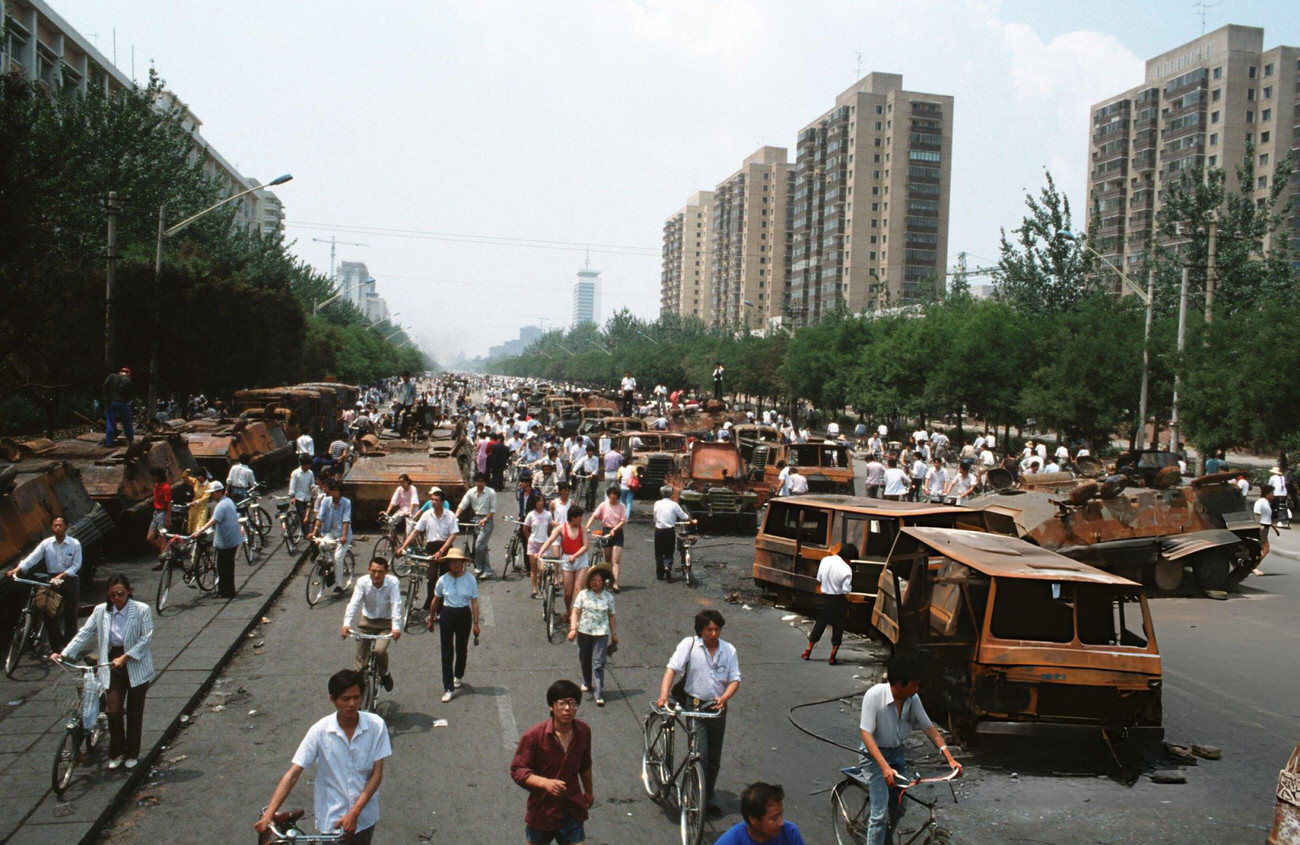
A broad city boulevard is clogged not by traffic, but by the remains of Chinese Army trucks and armored vehicles—burned, battered, and left sitting like hulks in the open. Onlookers move between them on foot and by bicycle, pausing to stare into charred cabins and twisted metal. The scale is striking: wreckage stretches into the distance beneath rows of high-rise apartment blocks and lines of trees.
In 1989, scenes like this became visual shorthand for a moment of intense confrontation, when military force and civilian presence collided in the streets. The calm curiosity of the crowd contrasts with the violence suggested by scorched paint, shattered parts, and dark stains on the roadway. Rather than a battlefield in the traditional sense, the setting feels like everyday urban life interrupted—residents and passersby reclaiming space while evidence of conflict remains in place.
For readers searching for historical photos of China in 1989, this image offers more than dramatic wreckage; it documents how ordinary people responded in the immediate aftermath, turning a devastated convoy into a public tableau. Details in the background—dense residential towers, a long straight avenue, and the sheer number of vehicles—help convey how large the event was and how quickly it engulfed a modern cityscape. It’s a sober reminder that “civil wars” and internal crises are often witnessed first-hand by civilians, not from distant front lines but on the very roads they use every day.