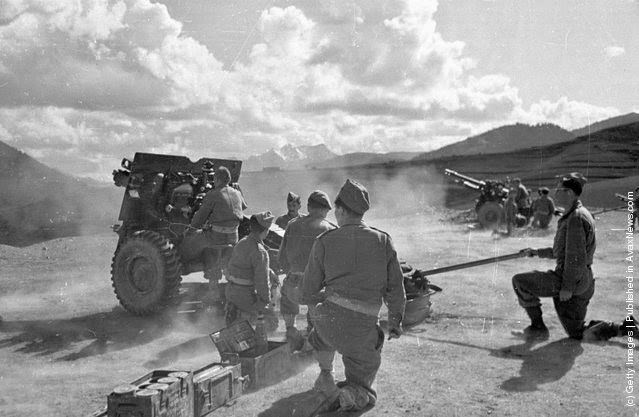
Dust hangs low over a rough mountainside as artillery crews in Greek army uniforms work their guns under a wide, clouded sky. Ammunition boxes and shell canisters sit in the foreground, emphasizing the logistics that fed the fighting as much as the rifles and resolve. In the midground, the gunners’ stances—braced, crouched, and intent—suggest the brief, practiced rhythm of loading and firing amid the chaos of the Greek Civil War.
Across the open ground, more pieces are positioned at intervals, turning the landscape into a battlefield grid of smoke, recoil, and shouted commands. The terrain reads as both beautiful and unforgiving: rolling slopes and distant ridgelines that could conceal guerrilla movement while forcing conventional units to rely on firepower and line-of-sight. The result is an image of modern civil conflict where the horizon feels too close and the air itself looks disturbed by blast and grit.
Seen through the lens of 1948, the scene speaks to a war fought not only between forces but within communities, where control of roads, hills, and villages carried enormous political weight. For readers searching Greek Civil War photos, Greek army artillery, or guerrilla warfare history, this frame offers a vivid reminder of how quickly pastoral countryside could become a firing position. It is a stark document of escalation—men, machines, and landscape locked together in a moment that still echoes in Greece’s twentieth-century memory.