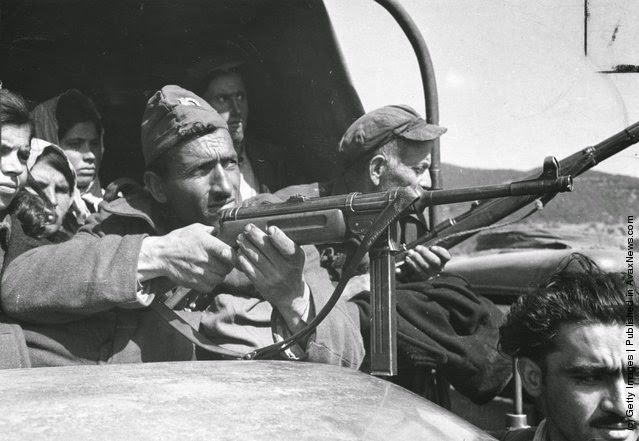
Pressed shoulder-to-shoulder in the back of an open vehicle, Greek National Guardsmen keep their rifles trained outward as they escort captives toward Drama in northern Greece. Hard faces, worn caps, and the tight grip on a long gun and submachine gun speak to a journey made under threat, where the road itself could be a front line. The prisoners, crowded behind the armed men, are carried along in the same cramped space, underscoring how quickly civilians and combatants alike could be swept into the machinery of the Greek Civil War.
In 1948, the conflict’s shifting control of territory turned movements like this into grim routine: retrievals from guerrilla-held areas, transfers to government-controlled towns, and the constant fear of ambush or reprisal. The title’s mention of “guerilla-occupied territory” hints at contested landscapes—villages and mountain routes where authority changed hands and loyalties were scrutinized. Details in the frame—alert stares, weapons held ready, and the exposed ride—convey the uneasy balance between discipline and desperation that defined wartime security operations.
For readers tracing Greece’s modern history, this photograph offers more than a record of uniforms and hardware; it captures the human tension of detention and transport in a civil war setting. Drama becomes not just a destination on a map but a symbol of state power reasserting itself amid fragmentation, while the prisoners’ presence raises questions about identity, accusation, and survival. As a searchable window into the Greek Civil War of 1948, the scene invites reflection on how conflict reshaped northern Greece, one convoy at a time.