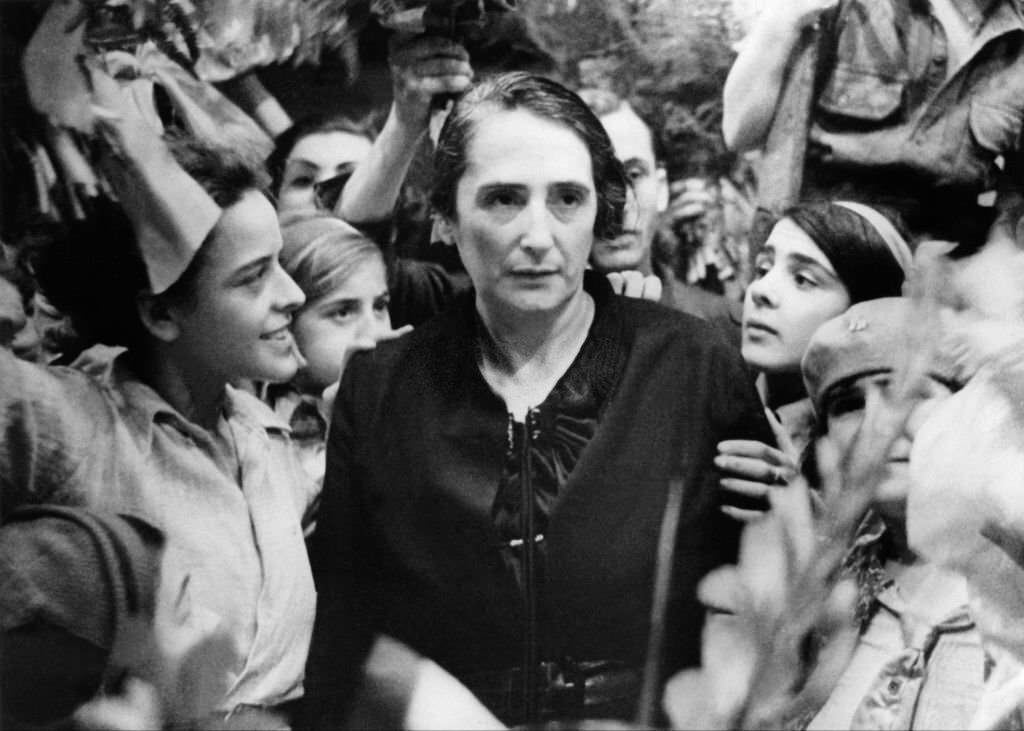
Amid a crush of outstretched arms and eager faces, Dolores Ibárruri—“La Pasionaria”—moves through the crowd with a steady, unsmiling calm. The camera catches her in close quarters, framed by women and children pressing in at her shoulders, their expressions ranging from admiration to expectation. In the blur of hands and bodies, the moment feels less like a posed portrait and more like politics lived in the street.
Ibárruri’s dark dress and composed posture draw the eye, a stark center against the surrounding motion that hints at chants, applause, and the urgent energy of the Spanish Civil War. Her gaze slips past the lens, suggesting a leader accustomed to public attention yet focused on what lies ahead rather than on the photographer. Details like the headscarf to one side and the crowded background evoke the era’s mass mobilization and the way civil conflict pulled ordinary people into the orbit of national figures.
For readers interested in Spanish Civil War history, this photograph offers a vivid study in wartime propaganda, popular support, and the cultivation of political icons. It also reminds us how quickly public life can compress into intimate spaces—an instant where personal presence becomes a symbol for a cause. Seen today, “La Pasionaria” stands not only as an individual but as a focal point for memory, resistance, and the contested narratives of civil wars.