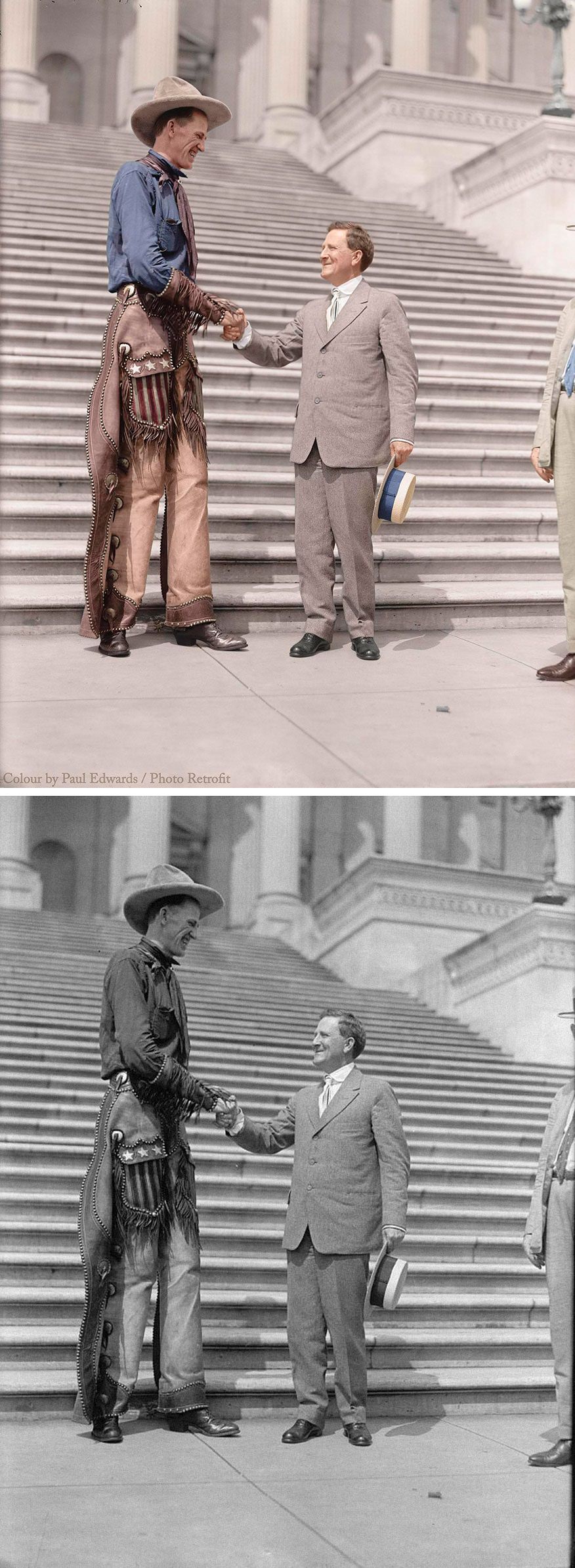
A handshake on a grand flight of stone steps becomes the whole story in “The Tall Cowboy,” where Ralph E. Madsen towers in full Western regalia beside Senator Morris Sheppard in a neatly tailored suit. The contrast is immediate and theatrical: a wide-brim hat and fringed leather chaps set against a straw boater held at the senator’s side, frontier flair meeting formal politics in a single courteous gesture. Even without a caption beyond the title, the setting’s monumental architecture frames the encounter like a civic stage.
Madsen’s outfit is rich with detail, from the stitched trim and dangling fringe to the star-spangled accents that draw the eye down the length of his chaps. His posture leans slightly toward Sheppard, smiling as they clasp hands, while the senator looks up with an expression that reads as cordial and amused. A third figure, only partly visible at the right edge, hints at a wider event or public moment just outside the frame.
The included colorization invites a different kind of looking, turning textures—leather, wool, stone—into something more immediate while keeping the 1919 atmosphere intact. For readers interested in American history, Western imagery, and early 20th-century political culture, the photograph works as both portrait and symbol: a tall cowboy made larger-than-life against the steps, and a senator representing the formal institutions of the era. It’s a memorable snapshot of how public identity, costume, and politics could meet in a single, carefully photographed moment.