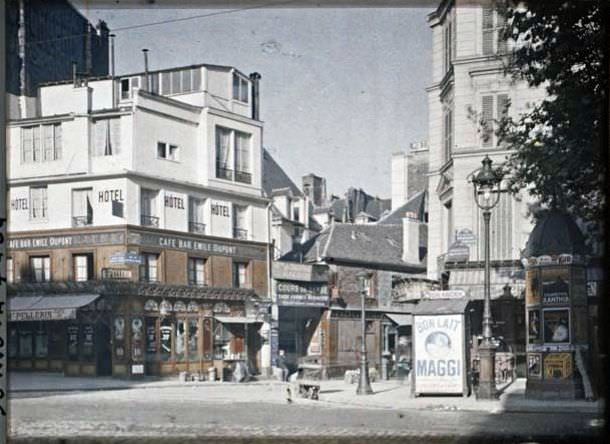
At the corner of Boulevard Beaumarchais and Rue du Pas-de-la-Mule, Stéphane Passet pauses on a lively Paris street where commerce and everyday routine meet at the curb. A hotel anchors the intersection, its façade layered with bold signage, while a café-bar below invites the passerby into the hum of conversation, coffee, and quick meals. The colorization brings out the gentle contrast between pale walls, darker roofs, and the painted lettering that once served as the city’s loudest advertising.
Shopfronts line the street with window displays and awnings, and the corner feels built for movement: pedestrians crossing, errands unfolding, and small deliveries likely threading through the open space. Posters and placards compete for attention, including a prominent advertisement board that reminds you how branded street marketing shaped the visual rhythm of the boulevard. Even without a named date, the architecture and street furniture evoke an older Paris, before modern traffic patterns and uniform storefronts smoothed away so much variety.
Seen today, the scene reads like a compact study of Parisian urban life—hotel, café, shops, and residential upper floors stacked into a single block of city fabric. Passet’s composition keeps the intersection legible and inviting, letting the eye travel from the corner building into the narrower street beyond, where rooftops and façades recede in layers. For anyone interested in historical Paris photography, early color processes, or the streetscape of Boulevard Beaumarchais, this image offers a rich, street-level snapshot of how the city once looked and felt.