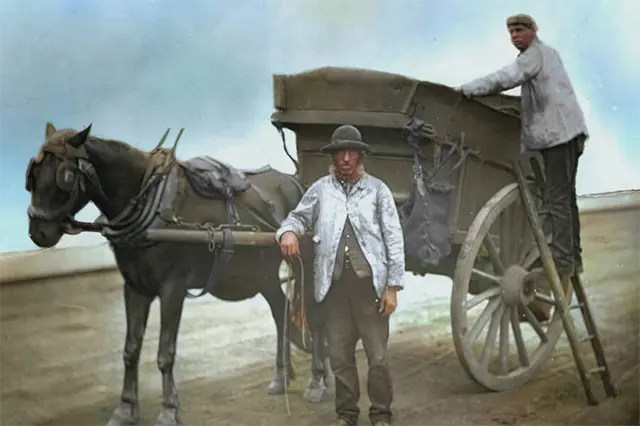
Horse, cart, and two working men form a quiet tableau of London’s “dust” trade in the 1890s, when ash and soot from countless coal fires had to be cleared away day after day. The colorization brings out the muted palette of a working street—weathered wood, worn clothing, and the solid build of the horse harnessed for heavy hauling. Everyday sanitation rarely made headlines, yet it underpinned urban life as surely as gaslight and brick.
At the center stands a dustman in a brimmed hat and pale work jacket, posed with the steady, unsentimental confidence of someone accustomed to long routes and heavier loads. Another man balances higher on the cart, ready to tip, shovel, or steady the haul, while the ladder hints at the practical improvisation of the job. Details like the wide wagon wheels and the piled container emphasize how this was manual labor scaled to a city’s appetite for fuel and the relentless byproducts it created.
London history is often told through grand buildings and famous streets, but the story also runs through trades like this one, where refuse became an industry and cleanliness a daily negotiation. Ash and soot were not merely “waste”; they were materials to be collected, moved, and managed—part of a broader Victorian and late-19th-century system that shaped public health and the look of the city itself. For readers searching for a genuine glimpse of Victorian London workers, dustmen, and horse-drawn street life, this restored image offers an unvarnished moment from the infrastructure of the past.