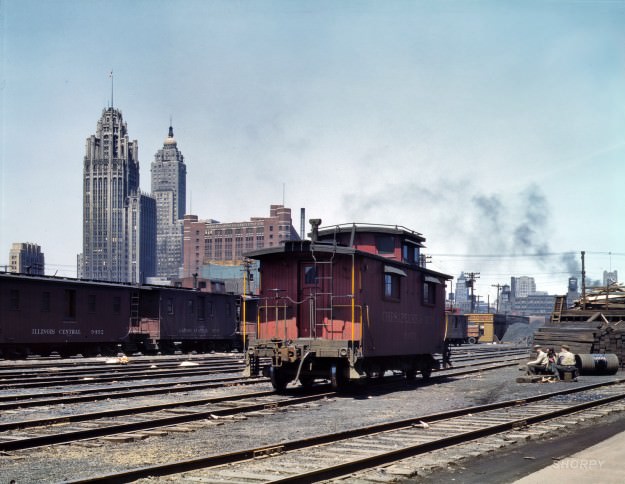
Rail lines spread across the foreground like a fan, leading the eye into Chicago’s busy South Water Street freight depot in April 1943. A weathered caboose sits on the nearest track, its warm, rusty reds and browns standing out against pale ballast and the cool haze of smoke drifting over the yard. In the distance, tall downtown buildings rise sharply, reminding you how tightly industry and city life were interwoven along the Illinois Central’s working waterfront.
Kodachrome color gives the scene a vivid, matter-of-fact immediacy: sunlit metal, creosoted ties, and the dull sheen of rail that has seen countless wheels. Boxcars line the left side, while scattered equipment and materials on the right hint at constant maintenance—an unglamorous but essential rhythm of freight operations. The mix of stillness and motion is palpable, as if the next switch, coupling, or departure is only moments away.
Taken by Jack Delano for the Office of War Information, the photograph reads as both documentation and quiet propaganda of competence—America’s logistics network in full stride during World War II. The mention of a Chesapeake & Ohio caboose amid Illinois Central trackage underscores how railroads intersected and cooperated, moving goods through shared arteries. For anyone searching Chicago railroad history, South Water Street freight depot details, or WW2-era rail yard photography, this frame offers a grounded look at the infrastructure that kept a city—and a nation—supplied.