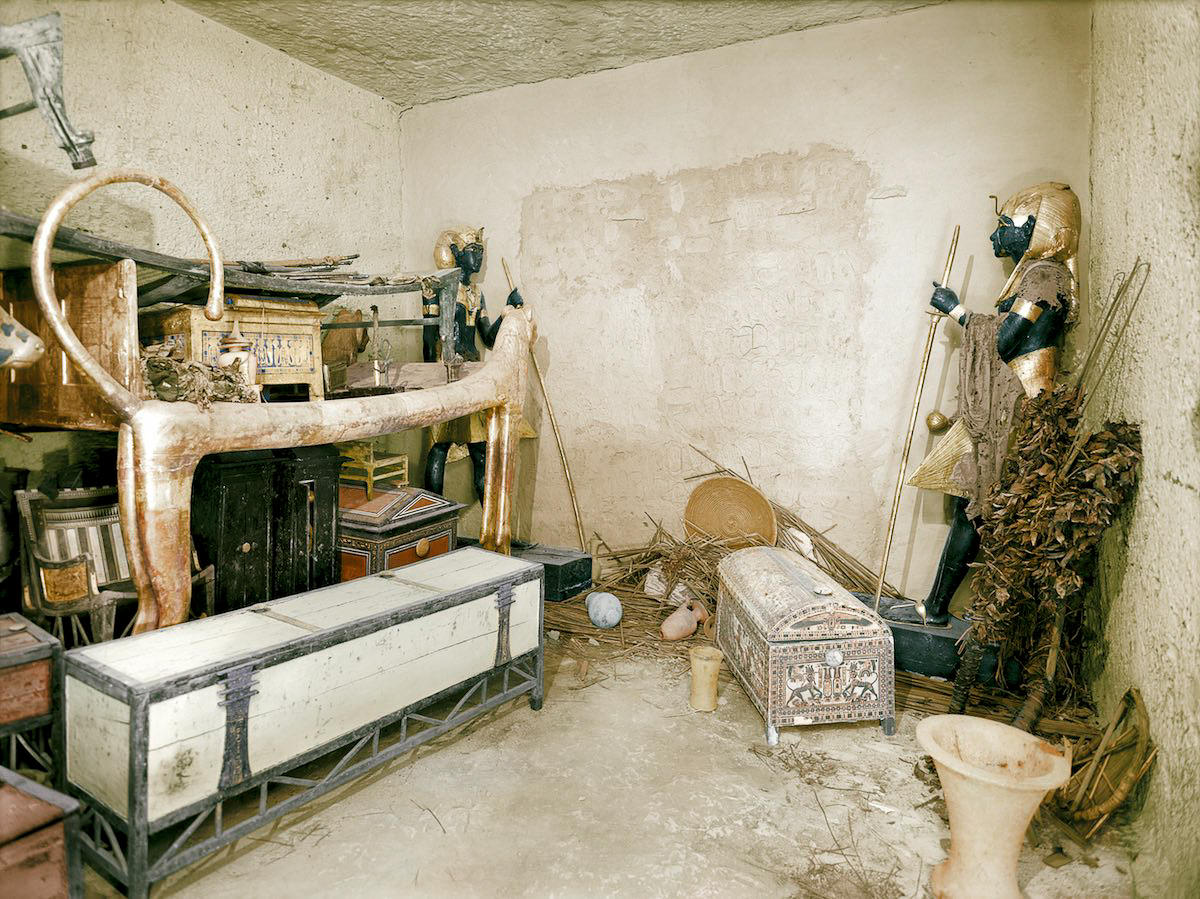
Along the northern wall of Tutankhamun’s Antechamber, two sentinel statues stand in formal silence, their dark faces and gilded details catching the muted light of an enclosed space. Each figure holds its staff like a ritual warning, positioned to flank the sealed doorway that led deeper into the tomb. The plastered wall behind them appears worn and uneven, a plain surface made more ominous by the certainty that it conceals the King’s Burial Chamber.
In the foreground, the chamber feels less like a museum display and more like a room paused mid-story: chests, boxes, and ceremonial objects crowd the floor, while larger furnishings press in from the left. A long white coffer stretches across the scene, and a richly decorated trunk rests near scattered rods and bundles, suggesting the careful, incremental work of cataloging and conservation. This colorized view emphasizes the contrast between polished ornament and the dusty, utilitarian reality of excavation inside Tutankhamun’s Tomb.
Dated December 1925 in the title, the photograph invites a closer look at the archaeology of thresholds—how a single sealed doorway could concentrate both scholarly attention and public imagination. The “Carter” numbering referenced for the guardians anchors the image in the meticulous recording system used to track objects from the Antechamber. For readers searching for Tutankhamun tomb photos, KV62 artifacts, or the famous guardian statues, this scene captures the tense stillness of discovery, where protection, secrecy, and awe occupy the same narrow room.