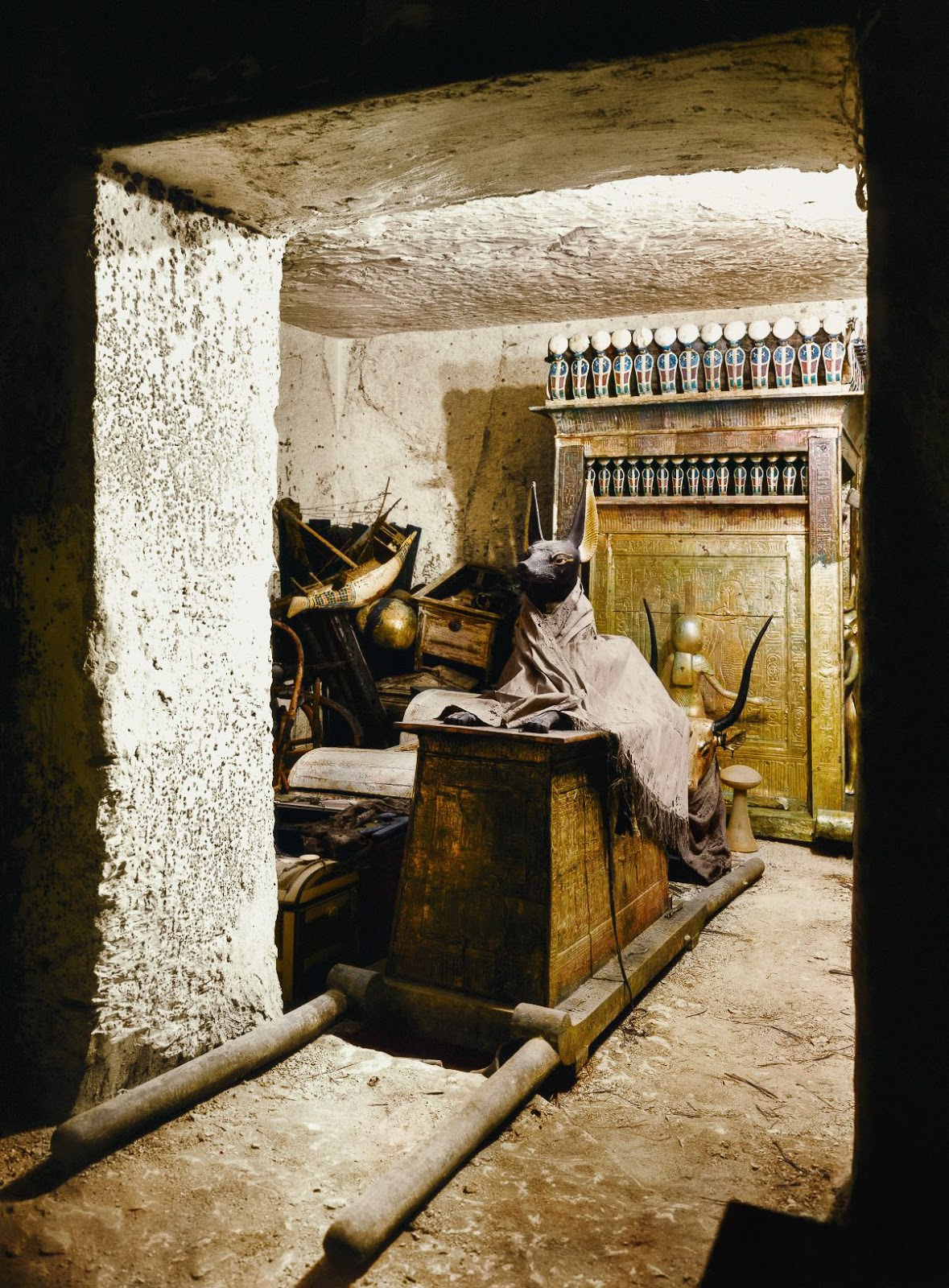
At the narrow threshold between the Burial Chamber and the Treasury stands the famed Anubis shrine, catalogued as Carter no. 261, its jackal-headed guardian poised in watchful silence. The colorization draws the eye to the deep blacks of the figure, the muted linen drape over its back, and the warm, dusty tones of the tomb’s plastered walls and low ceiling. In the foreground, long wooden carrying poles lie on the floor like discarded oars, hinting at the careful labor required to move sacred objects through such confined spaces.
Behind the shrine, gilded surfaces glow softly in the dim interior, their panels crowded with incised patterns and protective imagery. A row of small blue-and-gold figures lines the upper edge of a larger cabinet or shrine, adding a rhythm of repeating forms that contrasts with the rough, irregular texture of the chamber architecture. The clutter of nested items—boxes, stands, and ritual equipment—suggests a storeroom packed for the afterlife rather than a display arranged for modern eyes.
Seen from this angle, the photograph becomes more than a record of an artifact; it reads as a moment of discovery frozen at a doorway, where the ancient logic of protection meets the modern process of documentation. Anubis, associated with embalming and the guarding of the dead, feels perfectly placed here as a sentinel at the Treasury’s entrance, reinforcing the idea of boundaries within the tomb—rooms, thresholds, and rules of access. For readers searching for Tutankhamun’s tomb treasures, Carter’s excavation records, or the Anubis shrine itself, this scene offers an evocative, SEO-friendly glimpse into the spatial drama of Egyptology’s most iconic burial assemblage.