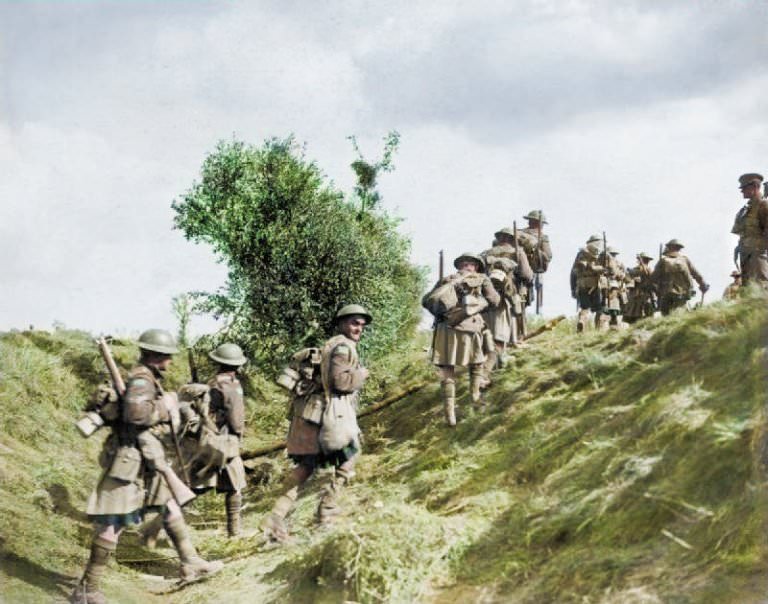
Climbing a grassy mound under a pale sky, Scottish troops move forward in a loose file, their rifles slung over their backs and their packs riding high on tired shoulders. Steel helmets catch the light, while the muted tones of the colorization bring out the khaki cloth, leather straps, and the scrubby green of the battlefield’s edge. The ground looks uneven and soft, a reminder that even “open” terrain could slow a unit down as surely as wire or shell holes.
What stands out is the practical weight of war: webbing, ammunition pouches, and essential kit arranged for marching and fighting, with each man keeping pace and spacing as the line crests the rise. A small tree and low brush provide the only cover, emphasizing how exposed an advance could be during the Battle of the Canal du Nord in 1918. The moment feels both routine and tense—an ordinary movement through an extraordinary landscape shaped by months of fighting.
For readers searching World War I photography, the Battle of the Canal du Nord, or Scottish soldiers on the Western Front, this colorized scene offers an immediate sense of scale and atmosphere. It bridges the distance between modern eyes and a century-old campaign, translating a well-known late-war offensive into the textures of grass, cloth, and sky. Seen today, the march reads as a snapshot of endurance: disciplined men pushing onward, one ridge at a time.