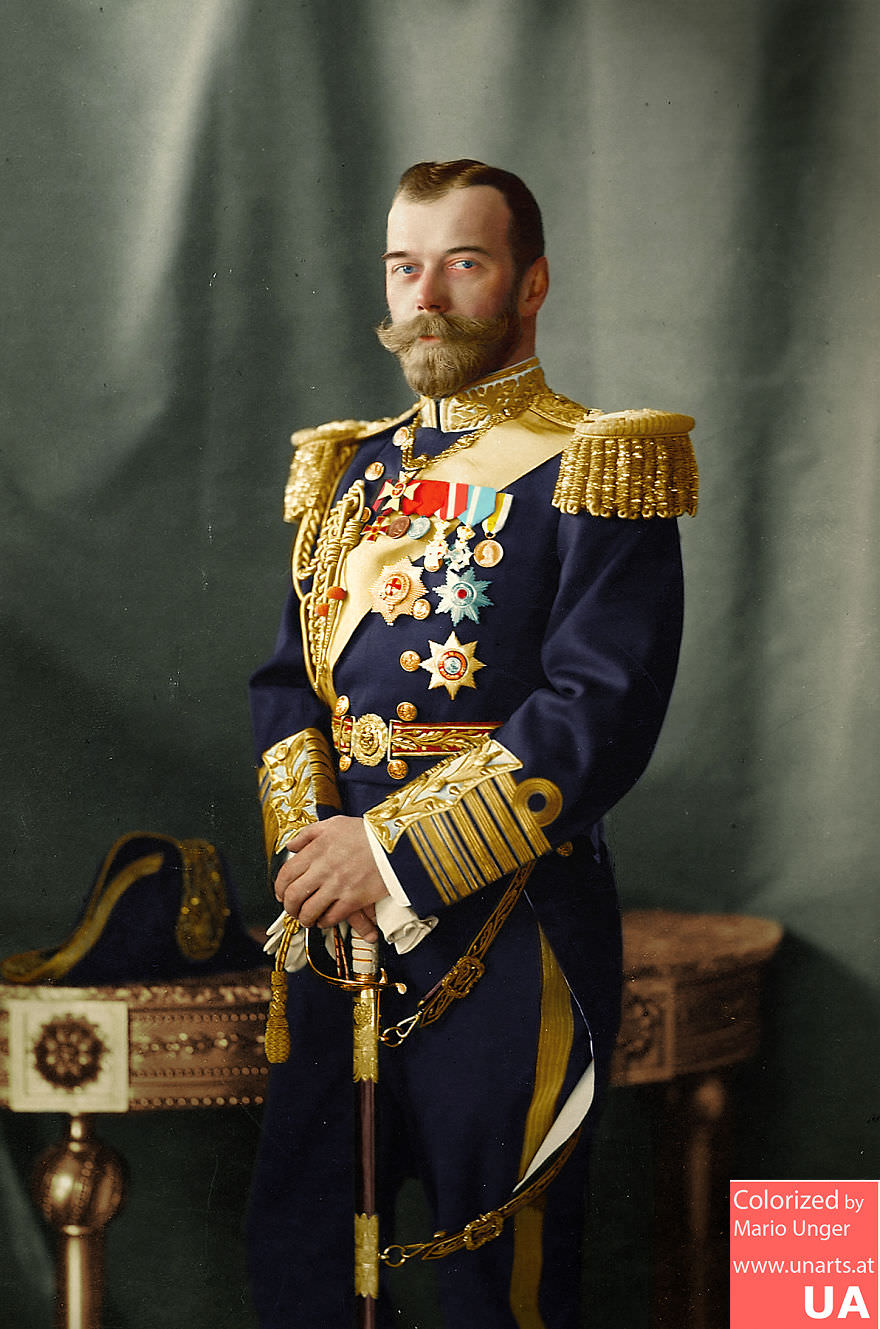
Against a softly lit studio backdrop, Tsar Nikolaus II stands in formal military dress, his posture composed and his gaze fixed outward with a calm, almost distant authority. The colorization brings a striking immediacy to the portrait: deep navy fabric, heavy gold embroidery, and a pale sash cutting across the chest like a ceremonial line of command. Medals and star-shaped orders cluster over the uniform, turning personal decoration into political symbolism, while the neatly groomed beard and mustache frame a face rendered with careful, human detail.
Details around him reinforce the language of empire and ceremony without needing any caption to explain it. A sword hilt rests in his hands, and the ornate belt, epaulettes, and cuffs emphasize rank and ritual as much as practicality. Off to the side, furnishings and a plumed hat suggest a controlled studio setting—part portrait, part understanding of power—crafted to communicate stability, tradition, and dynastic prestige.
For readers interested in Russian imperial history, Romanov-era imagery, and the art of historical photo colorization, this post offers a vivid way to engage with a well-known monarch as a living presence rather than a distant figure. Color can change how we read a photograph: it highlights textures, separates insignia from cloth, and draws attention to the careful staging behind official portraits. Seen today, the image invites reflection on how monarchy presented itself to the world, and how modern restoration techniques can reshape our encounter with the past.