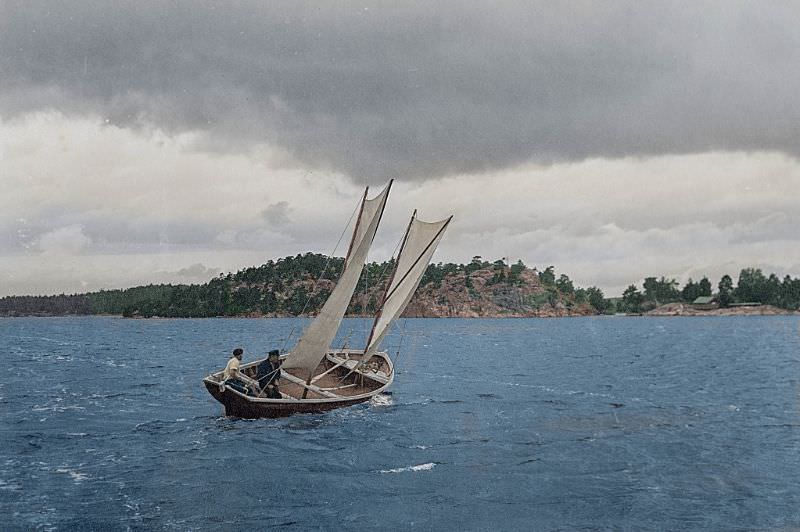
Against a low ceiling of gray cloud, a small traditional fishing boat rides the choppy blue water of the Finnish archipelago in 1932, its two pale sails pulling steadily toward a line of rocky, pine-topped islands. The hull sits close to the surface, built for working rather than display, and the sea’s texture—short waves and scattered whitecaps—suggests a day when skill mattered as much as luck. Colorization brings an immediacy to the scene: cold northern light, steel-toned sky, and the deep maritime blues that define these coastal waters.
Two figures keep their balance in the open boat, one near the stern and another closer to midships, their posture focused on the wind and the sail trim. The simple rigging, the low freeboard, and the compact working space evoke a livelihood shaped by practical choices—boats designed to move between sheltered sounds and exposed crossings. Even without nets or catch visible, the image speaks to everyday labor at sea, when small crews relied on intimate knowledge of currents, weather, and shoreline landmarks.
In the wider story of Finnish maritime heritage, scenes like this anchor the interwar years in something tangible: islands on the horizon, a working craft under sail, and the quiet resilience of coastal communities. For readers searching for Finnish archipelago history, traditional fishing boats, or authentic glimpses of 1930s seafaring, the photograph offers both atmosphere and detail without theatrics. It’s a reminder that much of the past survives not in grand events, but in ordinary passages across familiar water.