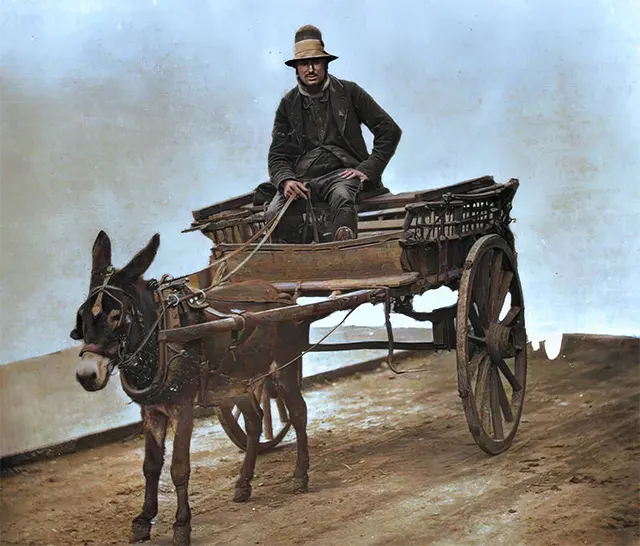
Perched high on a simple two-wheeled cart, a costermonger rides with an easy, workingman’s confidence as his donkey waits patiently at the traces. The colorization brings out small, telling details—the worn brim of a straw hat, the dark, creased clothing suited to long hours outdoors, and the rough timber of the cart built for practicality rather than show. Even the animal’s harness and the cart’s rails speak to daily use, repaired and reused as needed.
Coster life in the 1890s depended on mobility, and the donkey-and-cart was the backbone of street trading for those who sold fruit, vegetables, and other affordable goods. Here, the arrangement is all function: a compact load space, a sturdy wheelbase, and just enough room for the driver to sit above his stock while navigating uneven roads. The scene hints at the rhythms of urban streets and market routes, where speed mattered less than reliability and the ability to stop, start, and bargain at a moment’s notice.
What makes this historical photo linger is its quiet honesty—man, animal, and vehicle forming a small, self-contained economy on a dirt track. With the softened tones of the colorized treatment, it’s easier to imagine the sounds and textures that original monochrome can sometimes keep at a distance: leather creaking, hooves on packed earth, wheels rattling over ruts. For anyone interested in Victorian-era street life and working transport, this coster and his donkey offer a vivid window into everyday survival and enterprise.