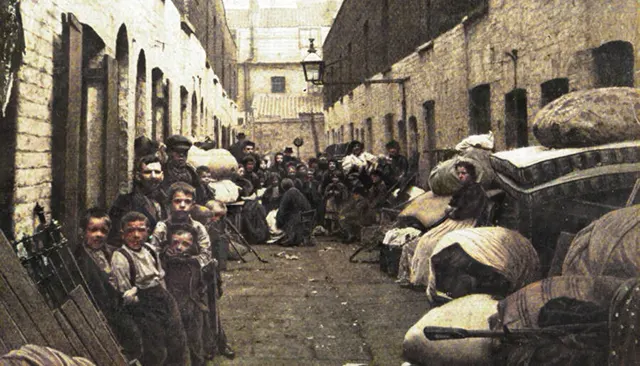
Down a narrow London alleyway, a whole household’s possessions spill into the open air—bundles of bedding, sacks, and a few battered pieces of furniture stacked along the brick walls. Children cluster close to the camera while adults sit or stand behind them, faces set with a mix of fatigue and wary attention. The colorization adds an immediate, lived-in quality to the scene, turning what might feel distant on the page into something uncomfortably present.
Brick tenements rise on either side, their small doorways and repeating arches hinting at crowded rooms and shared courtyards where privacy was scarce. A single streetlamp and the tight corridor of light draw the eye deeper into the passage, where more neighbors gather and watch, suggesting that hardship here was communal as much as personal. What’s striking is how public the family’s life becomes when everything they own is reduced to portable heaps—home, security, and identity laid out for the street to judge.
Seen through the lens of 1901, the photograph speaks to the realities of urban poverty in Edwardian London: displacement, precarious work, and the thin line between having a room and having nowhere at all. For readers interested in London slums, social history, and the human stories behind statistics, this image offers a direct encounter with the material culture of survival. It’s a reminder that “belongings” can be both ordinary objects and the fragile boundary that separates a family from complete destitution.