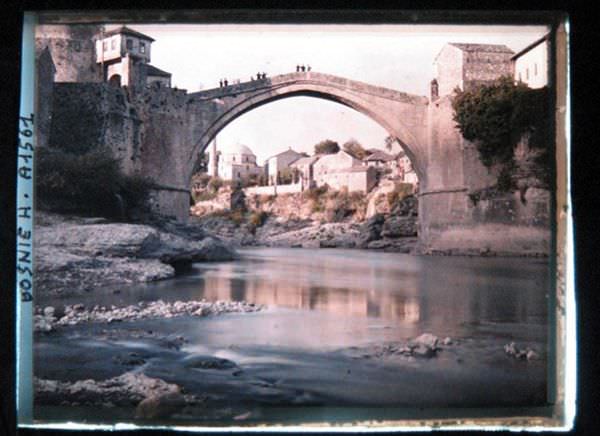
An elegant stone arch rises above a calm river, linking two rocky banks and framing a compact town beyond. Small figures appear along the crest of the bridge, turning it into both thoroughfare and lookout, while sturdy towers and clustered buildings press close to the water’s edge. The scene feels distinctly Bosnian in character, with the bridge acting as the visual and social center of the landscape.
The colorization brings new life to the early-1900s atmosphere, softening the stark contrasts of the original and drawing attention to textures—weathered masonry, eroded shoreline, and the glassy surface of the river. Subtle tones suggest late-afternoon light, where the span’s shadow falls gently and the town’s pale facades stand out against the rugged terrain. Even without identifying labels, the balance of architecture and natural setting evokes the layered history of Bosnia’s river towns.
Seen today, this historical photo offers more than a picturesque view; it hints at everyday movement, commerce, and conversation flowing across the bridge as surely as the water below. It also underscores how infrastructure shaped community life in Bosnia during the 1900s, tying neighborhoods together and anchoring settlement patterns along the river. For readers interested in Bosnian history, historic bridges, and early colorization work, the image provides a vivid window into a world poised between tradition and modern change.