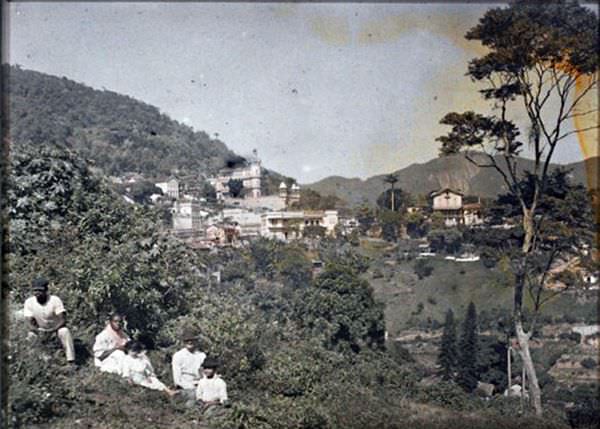
Across a quiet hillside, a small group sits in the grass and looks out over a Brazilian settlement, the kind of everyday pause that rarely makes it into official histories. The colorization brings soft greens and sun-washed tones to the scene, helping modern viewers read the terrain—dense vegetation in the foreground, scattered buildings in the middle distance, and a sweep of mountains beyond. Instead of a posed studio portrait, the moment feels lived-in and unhurried, offering a grounded glimpse of Brazil in the 1900s.
Below the slope, houses and larger structures cluster along the valley, suggesting a town in the midst of growth, where nature still presses close to daily life. A tall, sparse tree frames the right side of the image like a landmark, while the layered hills create depth and emphasize how settlements often hugged the contours of the land. Details may be indistinct at this resolution, yet the overall composition speaks clearly: a landscape where rural greenery and built spaces meet, typical of many Brazilian regions during the early twentieth century.
Colorized historical photos like this one invite a different kind of attention, making the past feel less remote without pretending it was modern. For readers searching for Brazil 1900s imagery, early 20th-century Brazilian landscapes, or colorized vintage photography, the view offers both atmosphere and context—people resting outdoors, a community in the distance, and the vastness of the surrounding countryside. It’s a reminder that history is not only made in grand events, but also in ordinary afternoons overlooking home.