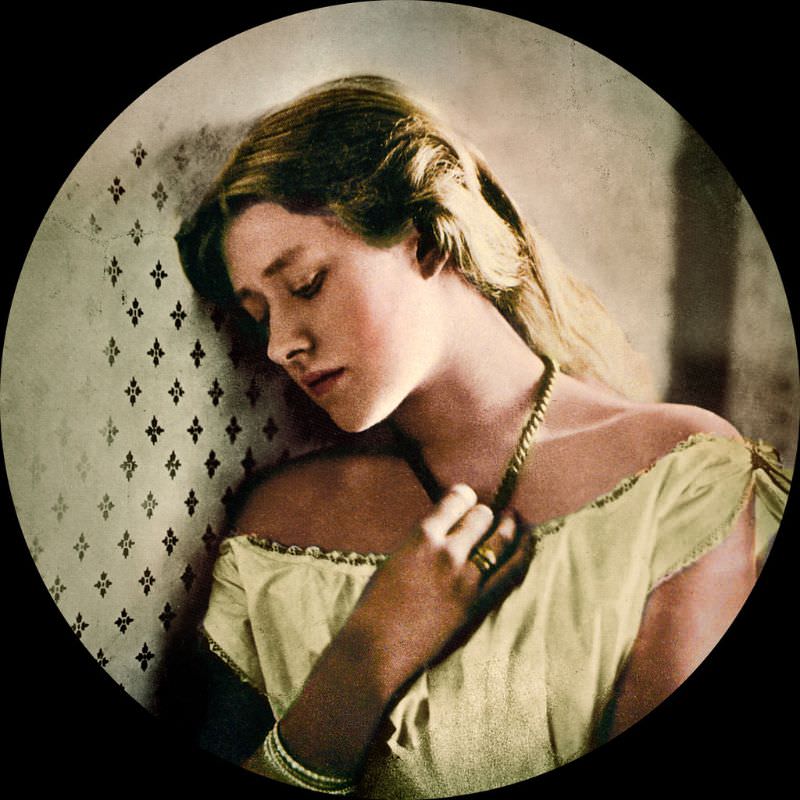
Ellen Terry appears here at sixteen, caught in a quiet, inward moment that feels more like a reverie than a formal sitting. Her head rests against patterned wallpaper, eyes lowered, while one hand gathers a chain at her throat—an intimate gesture that softens the boundary between portrait and private thought. The oval framing and gentle fall of light emphasize the curve of her profile and the delicacy of her off-the-shoulder dress.
Julia Margaret Cameron’s approach to portraiture was never merely documentary, and this work carries her hallmark sense of psychological presence. The softened focus, close composition, and restrained background turn Terry’s face into the true landscape of the photograph, with texture and tone doing the work of narrative. Even in colorization, the image retains that Victorian studio atmosphere—hushed, contemplative, and deliberately poetic.
Made in 1863, around the time of Terry’s marriage to G. F. Watts, the portrait sits at a crossroads of youth, celebrity, and expectation in the 19th century. It offers a compelling glimpse into early actress photography and the way Cameron helped elevate photographic portraits into art. For readers interested in Victorian culture, theater history, and classic photographic technique, this is a striking meeting of a future stage legend and one of the era’s most influential photographers.