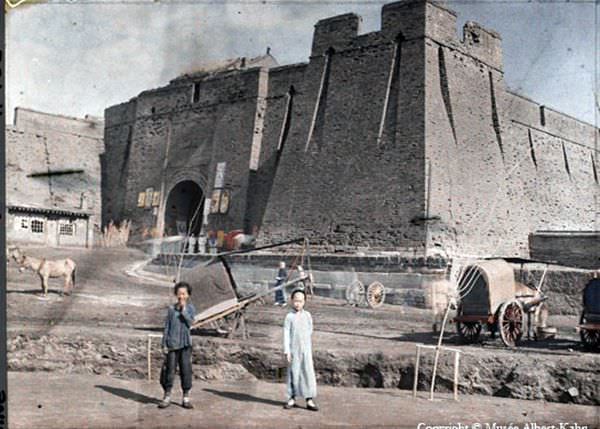
Sunlit dust and pale, newly added color wash over a massive city gate, its thick earthen walls buttressed with angled supports and capped by a simple watch structure. A broad arched entrance leads into shadow, while the roadway in front looks rough and rutted, hinting at constant traffic and ongoing wear. The soft tones of the colorization give the scene an immediacy that a monochrome print often hides, turning masonry, sky, and ground into something you can almost feel.
In the foreground, two figures stand apart on the uneven roadside, posed as if asked to hold still for the camera’s long attention. Nearby, a donkey and several covered carts suggest everyday movement of goods—market supplies, household items, or agricultural produce—passing beneath the defensive architecture that once defined urban life in China. The contrast between human scale and the towering wall emphasizes how these fortifications were not just military structures but also the backdrop to routine work and travel.
Early-1900s China sits at the intersection of tradition and change, and this view speaks to that transition without needing grand captions. The gate, the carts, and the simple street scene offer strong visual cues for anyone interested in Chinese history, old city walls, and the lived experience of the era. As a colorized historical photo, it also invites a second look—less as a distant relic, more as a moment on an ordinary day preserved at the threshold of a fortified town.