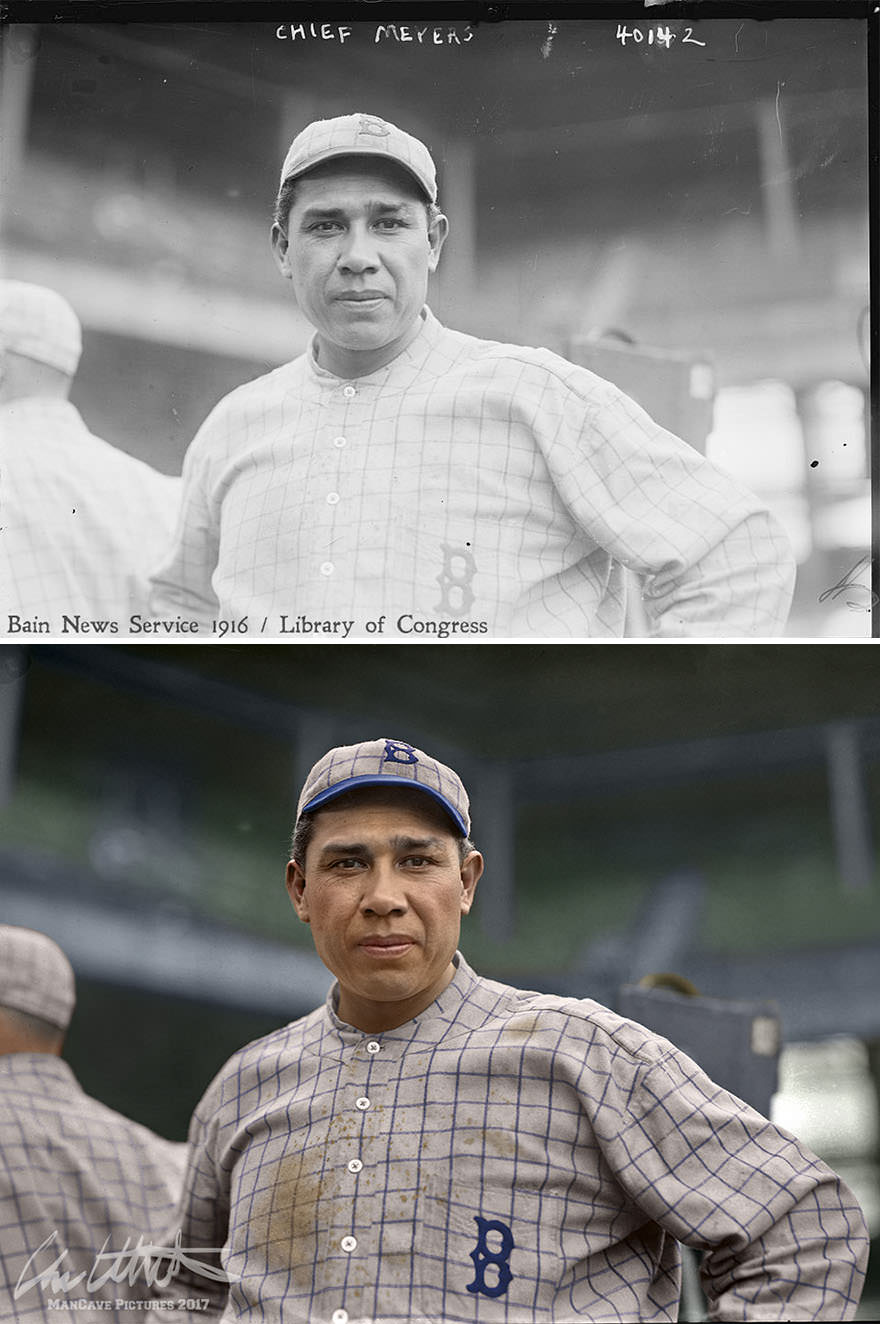
A steady gaze meets the camera as “Chief” Meyers stands in a Brooklyn uniform, the bold “B” on his jersey and cap anchoring the portrait in the world of early professional baseball. His checked flannel, buttoned front, and relaxed hand-on-hip stance feel both formal and familiar—part athlete, part workingman—framed by the blurred geometry of a ballpark behind him. Even without action on the field, the photograph carries the quiet confidence of a player caught between innings, aware that the moment is being preserved.
The paired presentation highlights how colorization can shift our relationship to a 1916 sports photo, turning textures and details into something newly legible. Fabric patterns sharpen, skin tones and shadows gain dimension, and the uniform’s lettering becomes a clearer emblem rather than a faint mark. Color doesn’t replace the past here; it acts like a lens, inviting longer looking and closer attention to the everyday material culture of the game.
For readers searching Brooklyn baseball history, early 20th-century athletics, or vintage sports portraits, this image offers a compact window into the era’s visual language—poses, uniforms, and the stadium atmosphere that surrounded the players. The title places Meyers in Brooklyn in 1916, and the photograph’s directness suggests the news-service style of the period: straightforward, documentary, and made to circulate. Seen today, especially in color, it bridges then and now, reminding us how a single portrait can carry team identity, personal presence, and the texture of a season long finished.