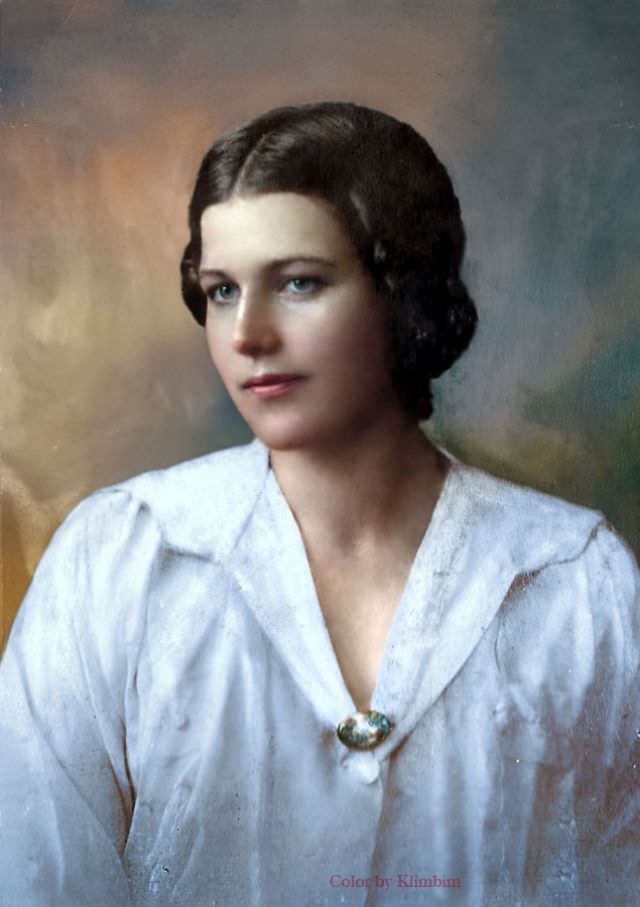
Larissa Reisner appears here in a poised late-1910s portrait, her gaze turned slightly to the side as if caught between a posed sitting and a private thought. The colorization gives her complexion a soft, lifelike warmth, while the muted studio backdrop keeps attention on her face and steady expression. Dark, neatly arranged hair frames her features in a style that fits the era, emphasizing the quiet elegance of early 20th-century photographic portraiture.
A simple light blouse with a wide collar and a small brooch at the neckline provides the only ornament, and that restraint feels telling—less about display, more about presence. The gentle gradients of color across the fabric and background suggest careful restoration choices, preserving the original photograph’s tonal balance while adding depth that black-and-white often conceals. Subtle details, from the sheen of the pin to the faint texture of the garment, make the image feel immediate rather than distant.
For readers searching Larissa Reisner late 1910s, restored portrait, or historical photo colorization, this post offers a thoughtful look at how modern techniques can renew an archival image without overwhelming it. Colorization does more than add pigment; it can sharpen our sense of the period’s material culture—skin tones, clothing, and studio lighting—while inviting closer attention to the subject’s character. In a decade defined by upheaval and transformation, this calm, direct portrait stands as a vivid reminder that history is also made of individual faces and quiet moments.