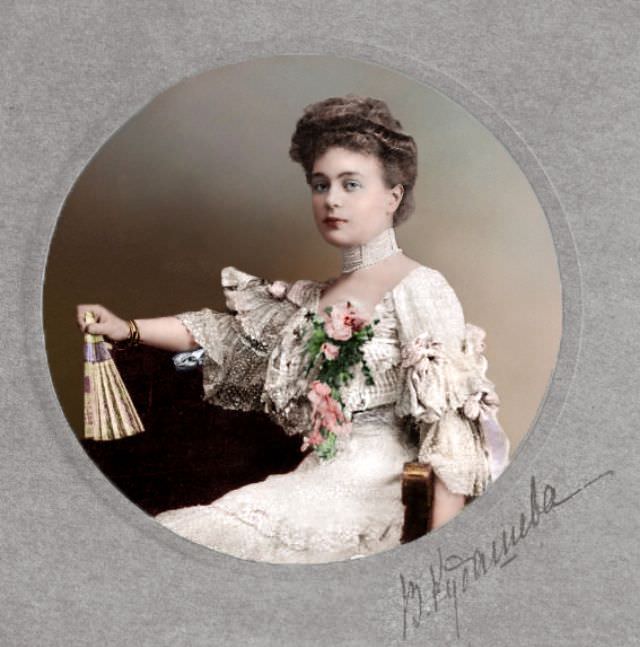
Poised within an oval studio frame, a young Russian woman from 1910 meets the viewer with a steady, composed gaze. The colorization brings a soft warmth to her complexion and emphasizes the era’s love of carefully arranged presentation, from the high, structured hairstyle to the refined posture that signals formality and self-possession.
Her dress is rich with period detail: a pale gown layered with lace, puffed sleeves, and decorative bows, paired with a high choker-style collar that was fashionable in the early twentieth century. A cluster of pink flowers cascades across the bodice, while she lightly holds a tasseled accessory in one hand—an elegant prop that hints at social rituals and the theater of portrait photography. The muted background and upholstered chair keep attention on texture and silhouette, letting fabric and ornament do much of the storytelling.
As a historical portrait, the image offers more than beauty; it serves as a window into pre-revolutionary Russian urban culture, studio aesthetics, and women’s fashion on the cusp of modernity. For readers interested in Russian history, early 1900s clothing, or the art of photographic colorization, this post invites a closer look at how identity was curated in front of the camera. The result feels intimate and immediate, bridging more than a century through careful restoration and color.