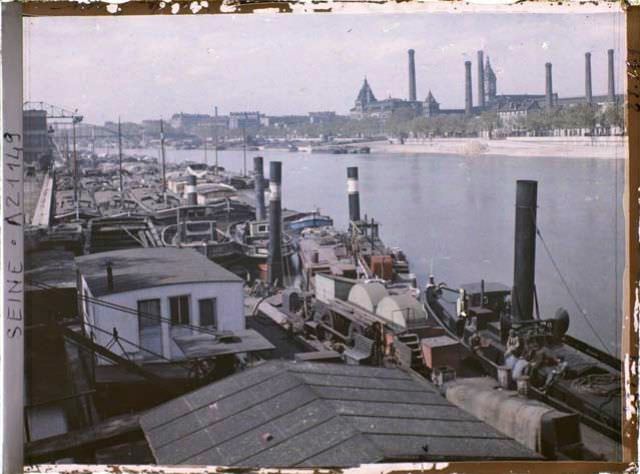
Along the broad sweep of the Seine, a line of working boats crowds the near bank, their dark smokestacks punctuating the pale sky like metronomes of industry. The colorization brings out the practical textures of river life—weathered decks, muted rooftops, and the soft blue-gray of water carrying reflections downstream. In the distance, Paris rises in layered silhouettes, where older stone forms and taller industrial structures share the horizon.
What makes this early 1900s street-and-river scene so compelling is its sense of motion without any single dramatic moment: barges and steam-powered craft sit ready, while the far embankment curves away toward bridges and busy quays. The scene hints at a city supplied by its river, with commerce, fuel, and goods moving through this watery corridor as naturally as pedestrians moved along nearby streets. Color, even when subtly applied, restores the everyday atmosphere—haze, sunlight, and the tonal differences between metal, masonry, and water.
For readers searching for a colorful look back at Paris in the early twentieth century, this restored view offers a grounded, working-city perspective beyond the usual monuments. It’s a reminder that “Paris street scenes” were not only boulevards and cafés, but also the riverside infrastructure that kept neighborhoods fed, warmed, and connected. The result is an inviting blend of history and visual storytelling, where the Seine becomes the main avenue and the city’s past feels close enough to hear.