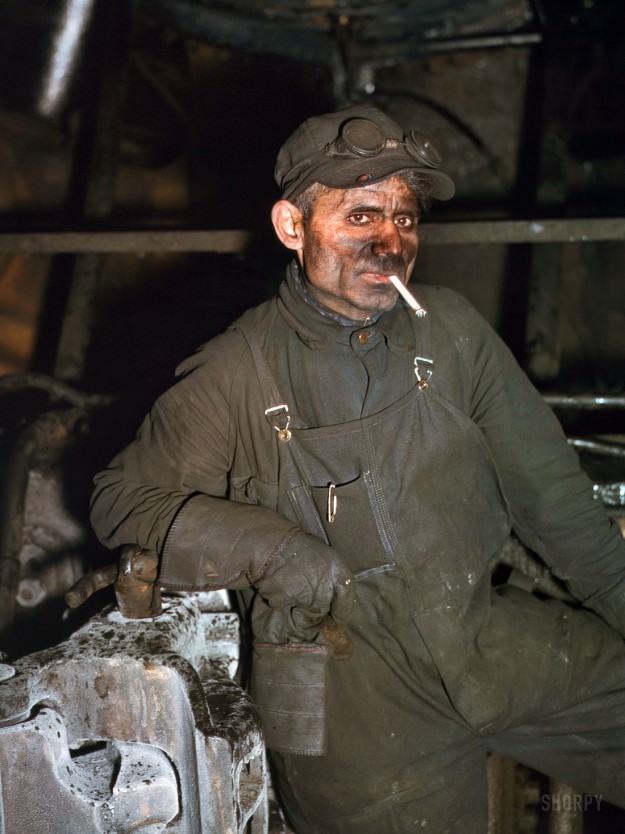
Grime and lamplight define this December 1942 scene from Melrose Park, Illinois, where a long-serving Chicago & North Western railroad worker pauses inside the roundhouse at the Proviso yards. His coveralls are dark with soot, goggles rest on his cap, and a cigarette hangs from his lips as if marking a brief, hard-earned break between tasks. The close framing pulls you into the work zone—metal surfaces dulled by oil, hands built for tools, and the quiet intensity of a man accustomed to heat, noise, and routine danger.
Jack Delano’s 4×5 Kodachrome transparency—made for the Office of War Information—adds a striking immediacy to the wartime railroad story. Color doesn’t romanticize the labor here; it clarifies it, turning the stains, sweat, and ash into a record of industrial reality rather than a distant legend. For readers searching for World War II home-front photography, railroad roundhouse life, or the Chicago & North Western RR in Illinois, this image offers a direct, human-scale view.
William London, noted in the title as having spent 25 years on the railroad, stands as a reminder that trains ran on experience as much as on steam and steel. The roundhouse at Proviso yards was more than a backdrop—it was an engine of maintenance and readiness, where skilled workers kept locomotives moving through a demanding era. What lingers is the expression: steady, tired, and composed, a portrait of working-class endurance rendered in the honest colors of the shop floor.