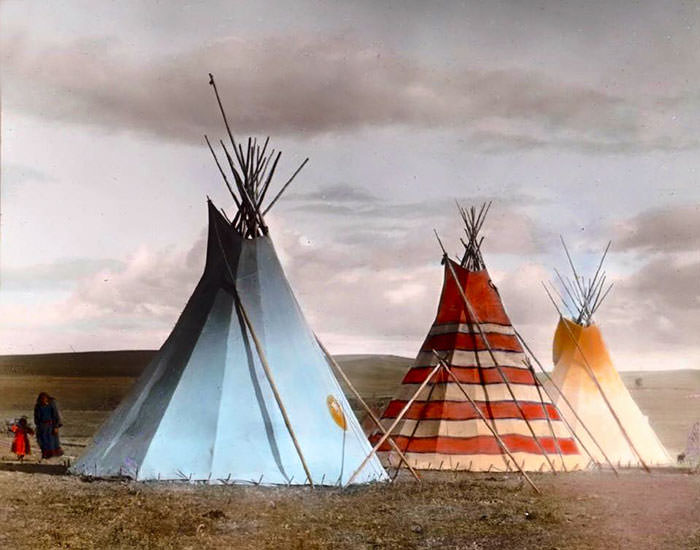
Under a wide Montana sky, three tipis rise from the open prairie, their poles clustered like crowns against a band of clouds. The colorization brings out distinct personalities in the camp: a pale blue lodge in the foreground with long, dark smoke flaps, a boldly banded red-and-white tipi nearby, and a warm yellow form set slightly back. Two small figures at the left edge of the frame hint at everyday movement and conversation within a Siksika camp setting.
The title names “Red Stripe Tipi” and “The Thunder Tipi,” inviting viewers to linger on the painted patterns and what they might have signified within Siksika life in the early 1900s. Tipi designs could carry family identity, honors, and spiritual associations, and even without close-up detail, the strong horizontal striping and confident color choices read as deliberate and meaningful. The arrangement also emphasizes traditional engineering—carefully balanced poles, taut covers, and the practical geometry that made these homes resilient on the plains.
As a historical photo, the scene sits at the intersection of continuity and change, preserving a moment when Indigenous material culture remained visibly rooted on its own terms. The open ground, the absence of buildings, and the calm spacing between lodges create a sense of scale that modern readers often miss when imagining early twentieth-century Montana. For those searching for Siksika history, Blackfoot tipi art, or early 1900s Indigenous life on the Northern Plains, this colorized image offers a vivid doorway into that world.