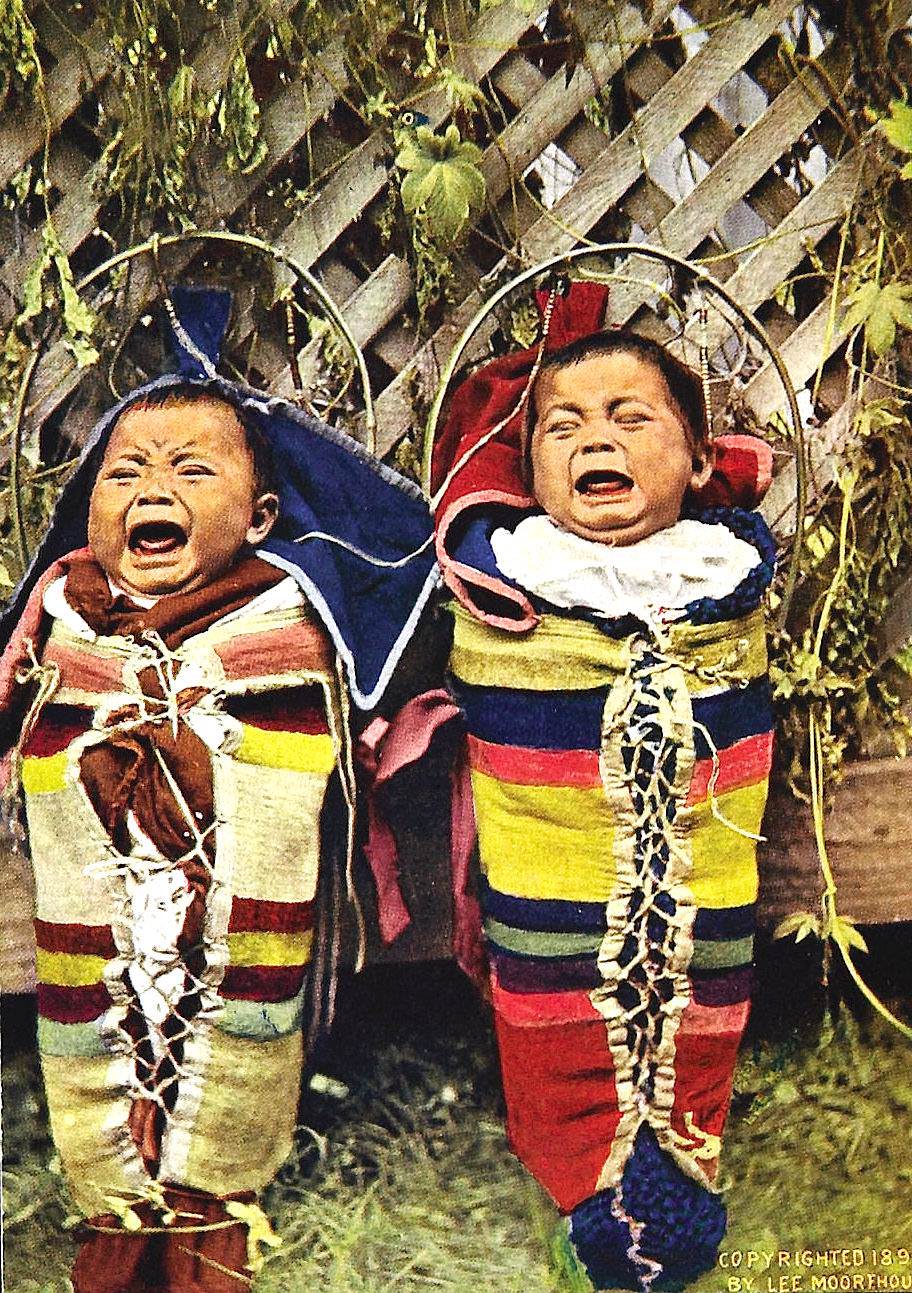
Two Cayuse twins, identified in the title as Tax-a-Lax and Alompum, are shown side by side in an arresting moment of early childhood—faces scrunched, mouths open, and voices seemingly raised in protest. They are snugly wrapped in bright, striped cradleboard-style coverings, each secured with lacing down the front, while curved wooden hoops frame their heads like protective halos. Behind them, a lattice fence and trailing greenery set an everyday outdoor backdrop that contrasts with the intensity of their expressions.
Colorization brings added immediacy to Lee Moorhouse’s 1898 portrait, drawing the eye to the saturated reds, blues, yellows, and greens of the textiles and the soft tones of skin and hair. The twin symmetry is striking: similar posture and scale, yet distinct blanket patterns and edging that help separate one child from the other. Even without staged smiles, the photograph communicates tenderness and realism, preserving a candid, human moment rather than an idealized pose.
Seen today, “Cayuse Twins (Tax-a-Lax and Alompum)” invites careful viewing as both a piece of Native American photographic history and a study in material culture—how clothing, wrapping, and craft appear in a late-19th-century image. The composition emphasizes family and identity through paired presence, while the hand-tinted color makes the scene feel close at hand for modern readers. For anyone researching Lee Moorhouse photos, Cayuse history, or historic colorized portraits, this image offers a vivid point of connection across time.