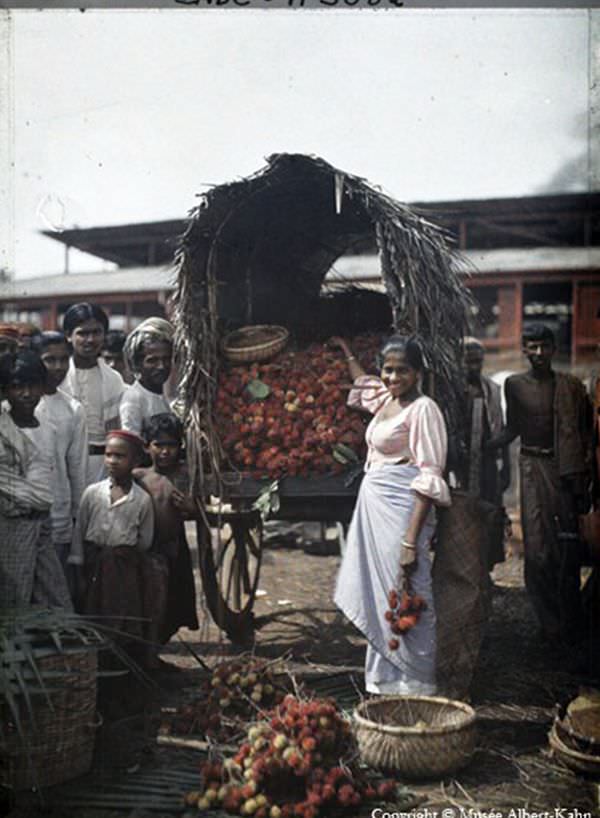
A burst of color spills from an open, palm-thatch-covered cart, piled high with rambutan—those bright, spiky fruits that instantly evoke Sri Lanka’s tropical abundance in the 1900s. Around it, a small crowd gathers with an easy familiarity, as if pausing mid-errand to watch the selling and sorting. Woven baskets on the ground hint at the steady rhythm of market life, where harvest moves from countryside to town in simple, practical containers.
At the center stands a woman in a light sari, smiling beside the fruit as though she’s both vendor and proud presenter of the day’s haul. The scene feels informal and communal: adults and children press in close, some in traditional dress, others in simpler everyday clothing, all framed by the cart’s curved canopy. Behind them, long low buildings suggest a busy public space—perhaps near a market lane or transport hub—where people, produce, and news would have circulated together.
Colorization brings out the warmth that older monochrome images can hide, making the rambutan’s reds and the sunlit whites of clothing feel immediate rather than distant. For readers searching for early 20th-century Sri Lanka photography, colonial-era street scenes, or historical market culture, this image offers a grounded glimpse into ordinary commerce and social life. More than a study of fruit, it’s a portrait of a moment when work, community, and seasonal bounty met in the open air.