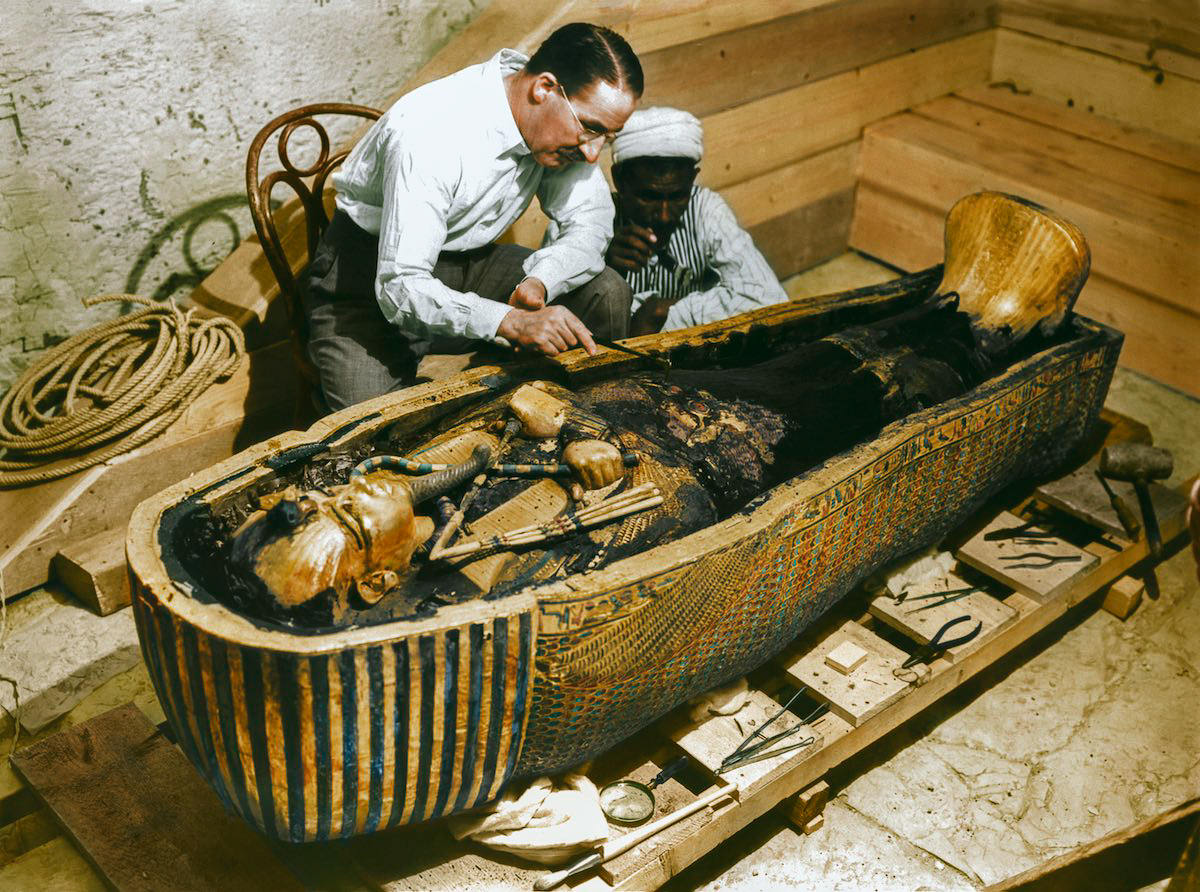
Under the harsh, close light of Tutankhamun’s burial chamber, Howard Carter leans over the opened nesting coffins while an Egyptian workman watches beside him, both men focused on the innermost lid and the fragile layers of funerary wrappings and ornaments within. The scene feels less like a dramatic “discovery” than painstaking museum work carried out underground: a chair pulled near for long hours, coil of rope ready for careful lifting, and a wooden-lined workspace built to steady priceless materials. Colorization draws the eye to the warm gleam of gold against the muted stone and timber, restoring a sense of presence to a moment often remembered only in monochrome.
The third coffin (Carter no. 255), described as solid gold, sits inside the case of the second coffin, its surfaces crowded with protective imagery and tight patterning that signal royal status and sacred purpose. Around the body lie ceremonial emblems and adornments—objects placed not for display, but for eternity—now interrupted by modern tools laid out on boards at the coffin’s side. That contrast, between ancient craftsmanship and the practical implements of excavation and conservation, makes the photograph one of the most intimate views of the tomb’s interior work.
Dated in the title to 30th October 1925, the image captures a turning point in the exploration of Tutankhamun’s Tomb, when legend became documentation and every adjustment had to be recorded, measured, and justified. It also quietly acknowledges labor and expertise shared on site, even if history tends to compress the story into a single famous name. For readers searching for Howard Carter, Tutankhamun, the golden coffin, or the step-by-step opening of the nested sarcophagi, this colorized photograph offers a vivid window into the careful, tense hours behind one of archaeology’s most enduring narratives.