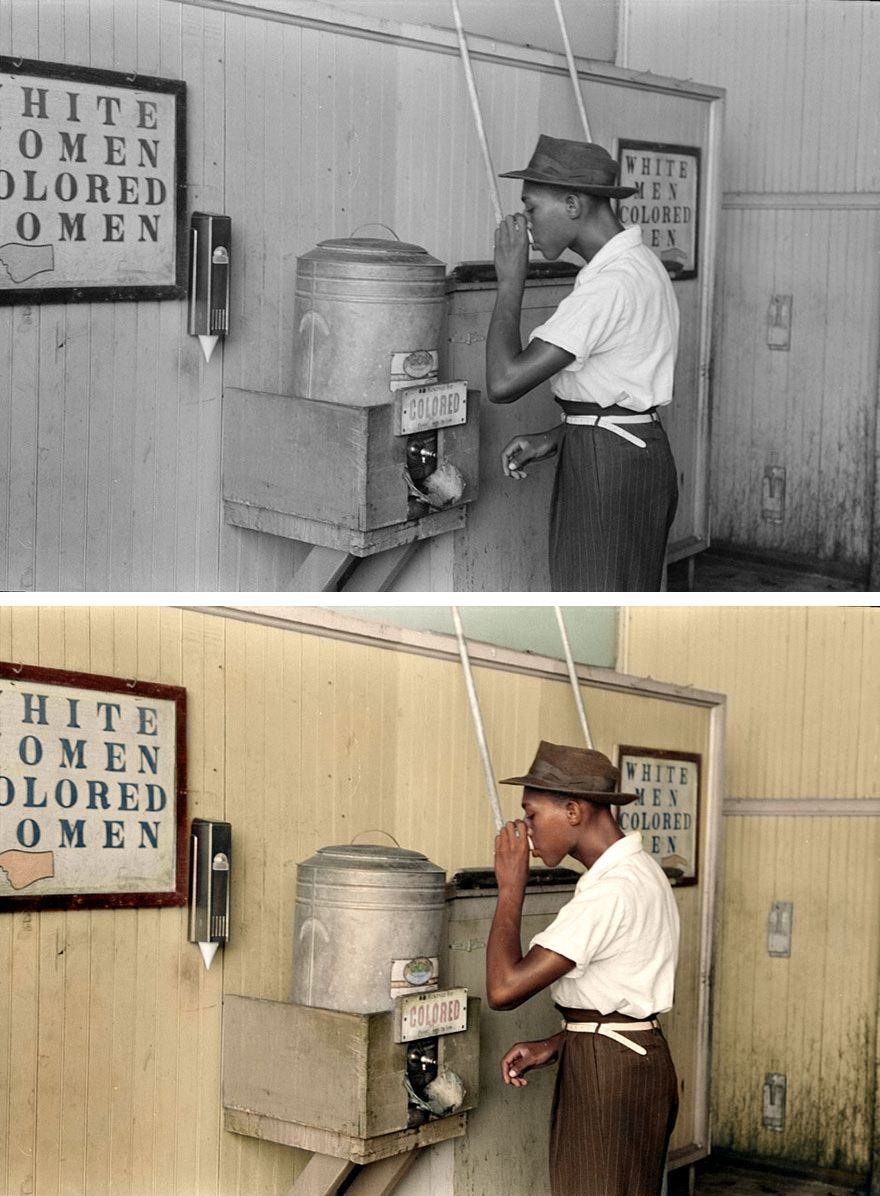
Inside an Oklahoma City streetcar terminal in July 1939, a young Black man pauses for a drink at a water cooler explicitly labeled “COLORED,” while nearby signage spells out the rigid hierarchy of “WHITE MEN,” “COLORED,” and “WOMEN.” The ordinary act of taking a sip becomes a quiet record of Jim Crow segregation, captured in a plain, workaday interior of wood-paneled walls and utilitarian fixtures. Even without knowing his name, the viewer can sense how public space was carefully managed—right down to who could drink where.
The details linger: a hat tipped forward, a short-sleeved shirt tucked neatly into high-waisted trousers, and the cooler’s metal reservoir set atop a rough wooden stand. On the wall, the separation is reinforced twice—once by the larger sign at left and again by a smaller placard in the background—making the rules impossible to miss. That repetition is part of the story, showing how segregation was not only enforced by law and custom but also communicated through everyday objects and routine directions.
A colorized version accompanies the original black-and-white, bringing new immediacy to the scene while keeping its stark message intact. Color draws attention to textures, wear, and the lived-in quality of the terminal, but it also emphasizes the harsh normalcy of discrimination in public transit spaces. For readers searching for historical photos of Oklahoma City, Jim Crow signage, or segregated water fountains, this post offers a direct visual document of how inequality was built into daily life—one public sip at a time.