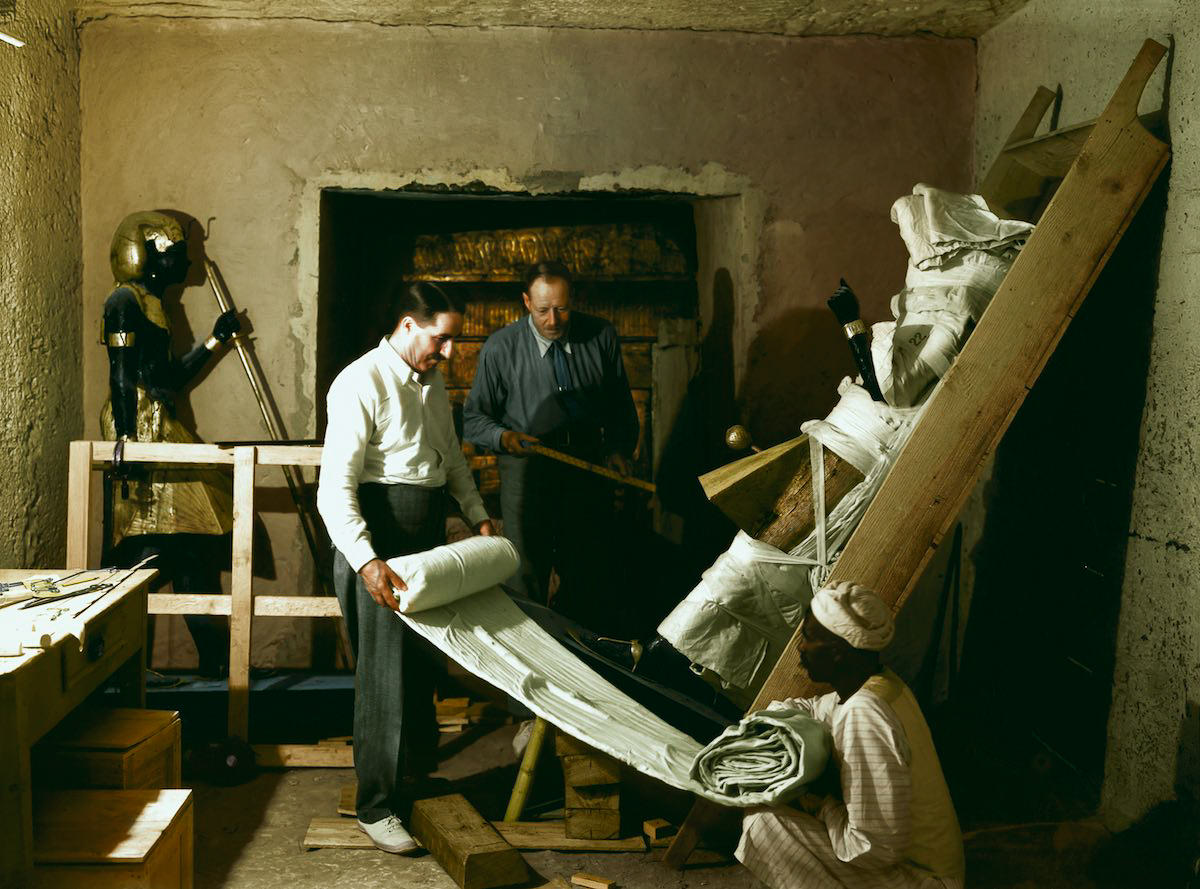
In the cramped, dust-toned antechamber of Tutankhamun’s tomb, Howard Carter stands at left with a long roll of protective cloth, focused on the careful work of safeguarding a royal guardian. Beside him, his friend and colleague Arthur Callender checks a measuring tape, while boards, crates, and makeshift supports crowd the floor—practical reminders that archaeology is as much engineering as it is discovery. The warm colorization brings out the ochres of the plastered walls and the muted gleam of gilded surfaces, lending immediacy to a moment often imagined only in stark monochrome.
A sentinel statue of Tutankhamun, one of the pair positioned as watchmen at the threshold, waits partly wrapped and braced, its dark profile and gold accents emerging from the shadows. Fabric drapes over the figure in layers, intended to cushion fragile surfaces during handling and transport, while nearby timber leans at sharp angles like scaffolding in miniature. Behind the men, the sealed doorway and stacked, gold-toned panels hint at deeper chambers and the painstaking pace required to move forward without damage.
December 1925 marked a mature phase of the excavation, when documentation, conservation, and controlled removal became the daily rhythm rather than the initial shock of discovery. The scene underscores the collaboration involved—specialists measuring, wrapping, lifting, and recording—turning a sensational find into a disciplined project that could be studied for generations. For readers searching the history of Tutankhamun’s tomb, Howard Carter, Arthur Callender, and the antechamber sentinel statues, this restored view offers a grounded look at the quiet labor behind one of archaeology’s most famous stories.