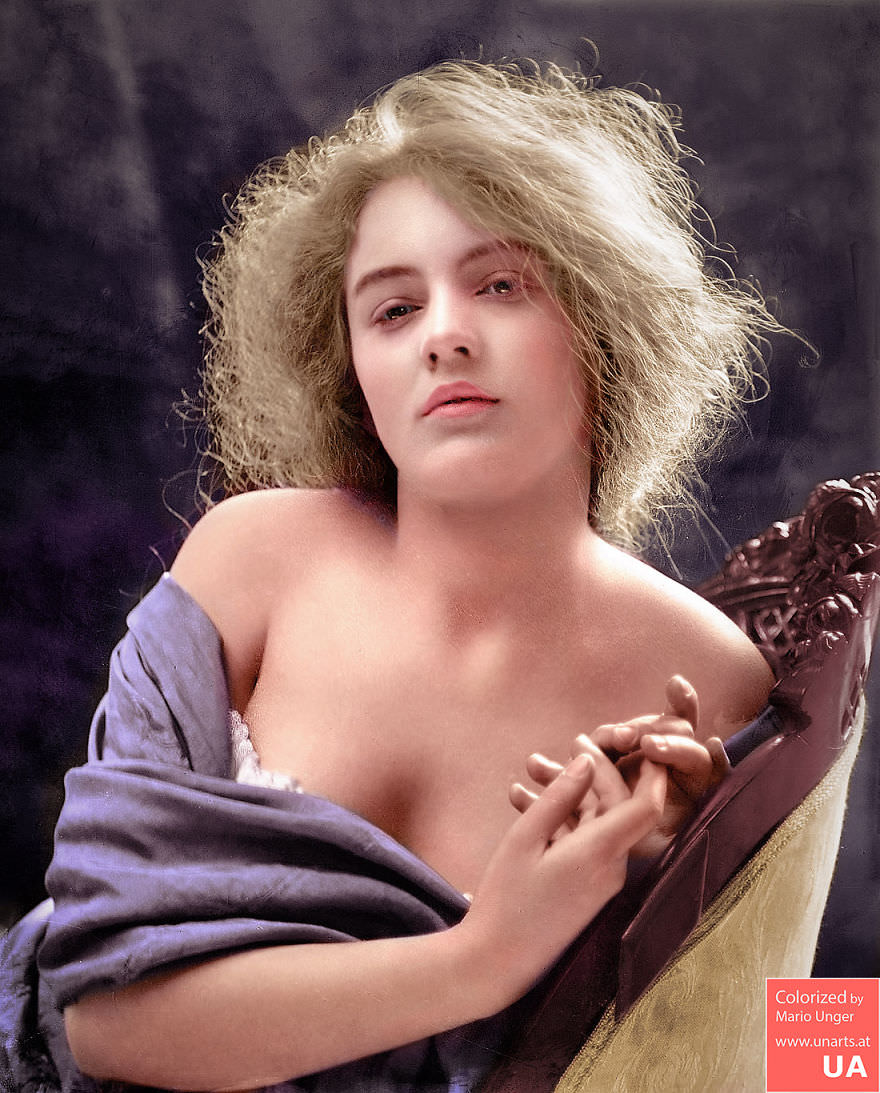
Evelyn Nesbit appears in a softly staged studio portrait that feels at once intimate and carefully composed, a hallmark of turn-of-the-century celebrity photography. The colorization brings forward the gentle warmth of skin tones, the pale sweep of hair, and the muted drape of fabric slipped from the shoulders, turning what might have been a distant artifact into a vivid encounter. Her direct gaze and relaxed, clasped hands suggest a practiced sitter—someone accustomed to the camera’s scrutiny and the public’s appetite for personality.
Light falls across her face and collarbone with a painterly touch, while the darker backdrop keeps attention fixed on expression and texture. The carved edge of the chair and the satiny wrap introduce a quiet note of luxury, hinting at the era’s taste for theatrical elegance in portrait studios. Instead of a stiff pose, the composition leans toward softness and mood, the kind of imagery that helped define early modern glamour.
As a historical image labeled “Evelyn Nesbit, 1900,” this colorized portrait invites readers to consider how fame was manufactured long before social media—through pose, wardrobe, lighting, and retouching. For anyone exploring Evelyn Nesbit photographs, early 1900s portraiture, or the broader visual culture of the period, the added color offers a fresh way to read details that monochrome can flatten. It’s less a mere enhancement than a translation, bridging a century of distance while preserving the photograph’s staged allure.