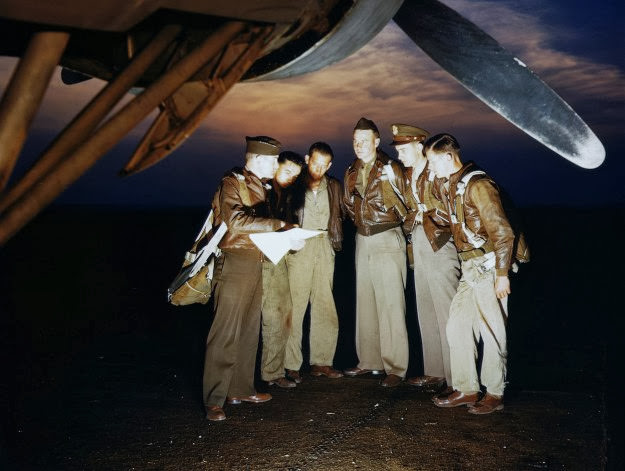
Beneath the broad wing and looming propeller of a YB-17 bomber, a tight circle of airmen leans in to catch final instructions on the tarmac at Langley Field, Virginia, in 1942. The colorization brings out the warm browns of leather flight jackets and the pale sheen of uniforms, turning a familiar wartime moment into something immediate and lived-in. Faces angle toward the briefing papers, suggesting the quiet urgency that settles in just before engines turn over.
Night or late dusk seems to press in around them, leaving the men and the aircraft’s underside lit like a small stage in an otherwise empty field. The bomber’s hardware—struts, metal skin, and the shadowed curve of the wing—frames the crew’s huddle, reminding viewers how much of World War II aviation was defined by machines that dwarfed the people who flew them. Even without visible insignia or readable maps, the scene communicates procedure and teamwork: a last check, a last reminder, and then separation into assigned roles.
For readers interested in WWII aviation history, Langley Field, and the early Flying Fortress era, this photograph offers a grounded look at how missions began long before takeoff. It isn’t a dramatic combat shot; it’s the human prelude—planning, listening, and trust—set directly under the aircraft they are about to board. As a historical image enhanced through colorization, it invites closer attention to small details of gear, posture, and light, while keeping the focus on the shared tension of departure in 1942.