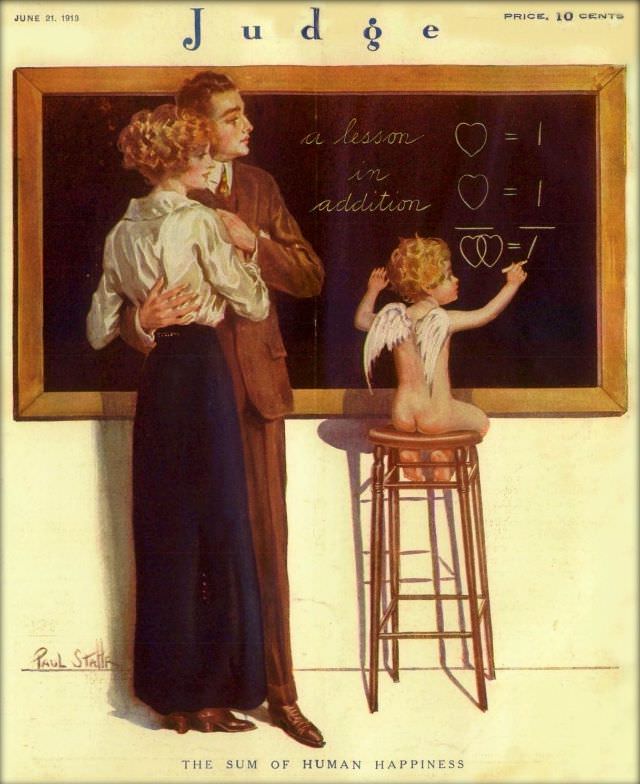
Across the top of the June 21, 1913 issue of *Judge* magazine, the bold title sits above a warm, painterly classroom scene that quickly reveals its punchline. A chalkboard bears the phrase “a lesson in addition,” while simple arithmetic is replaced by hearts that become a paired set—romance rendered as math. Even the cover’s small details, like the clearly printed “Price, 10 cents,” help anchor the illustration in the everyday magazine culture of the early twentieth century.
At the center, a well-dressed couple stands close together, their posture suggesting courtship and shared amusement, while a small child—drawn with angel wings—perches on a tall stool and reaches up to finish the “problem.” The contrast is deliberate: adult affection framed as a lesson, and innocence literally writing the rules on the board. Soft colors, careful shading, and period clothing turn a simple gag into a scene that feels both domestic and theatrical.
As cover art, it’s a compact example of how *Judge* used visual satire to comment on love, marriage, and the “sum” of happiness without needing a single column of text. The composition invites viewers to read the chalk marks like a caption, then linger on the expressions and gestures that sell the joke. For collectors and researchers searching for Judge magazine covers, 1913 illustration art, or early American humor magazines, this issue offers a memorable snapshot of the era’s playful editorial style.